

CHAPTER 1
"...the origin of time and the destiny of the world..."

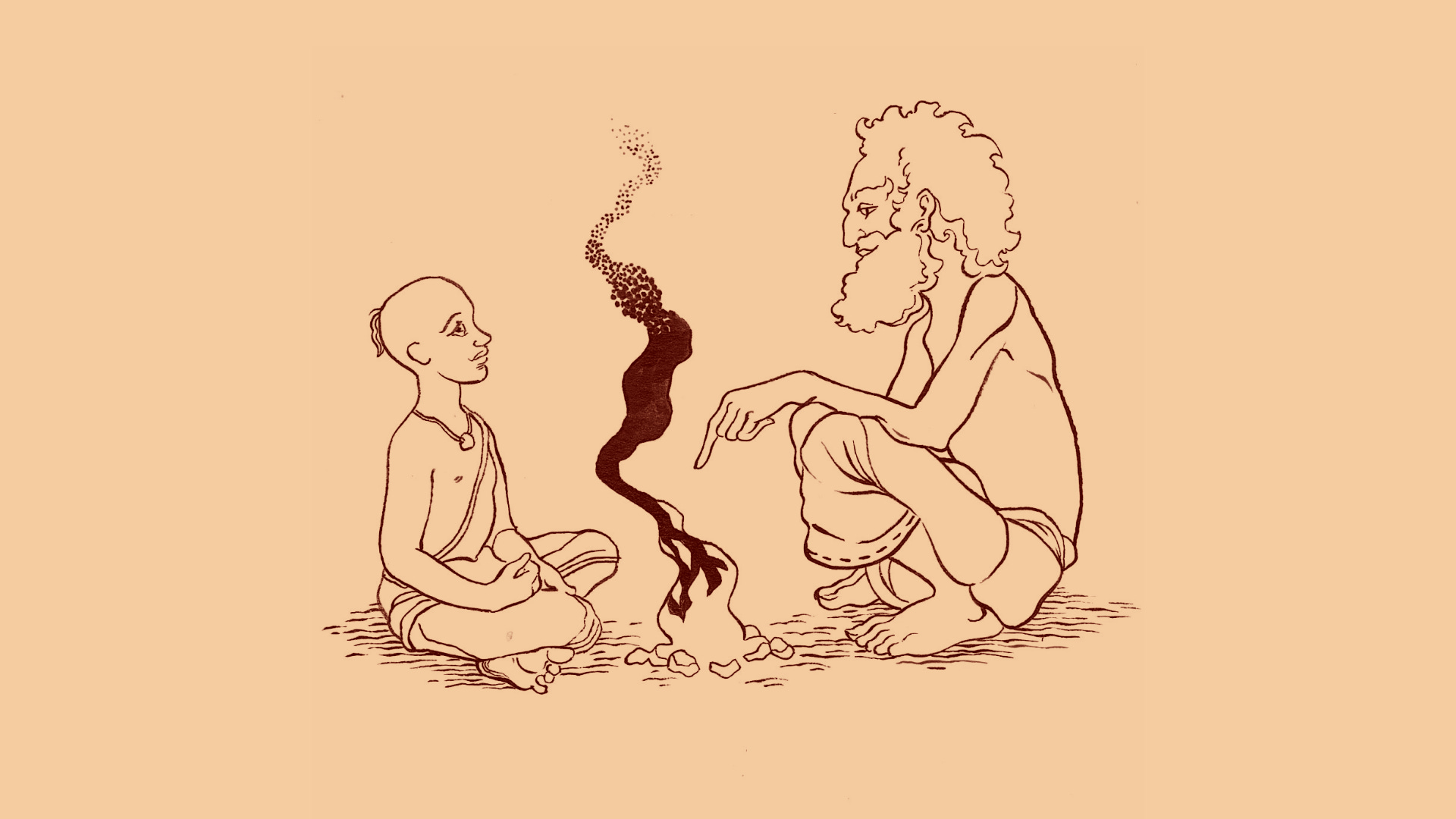
“Now listen to a story: Bhishma, the commander of the Kaurava army, lay in the battle-field, preparing to give up his life. The Pandava brothers, accompanied by Krishna, stood by the fallen hero, paying their last respects. And then they noticed that the venerable Bhishma was crying, tears rolling down his cheeks. At this, Arjuna remarked to Krishna, ‘Brother, what an astonishing sight this is! Our grandfather, Bhishma, the man who always stood by Truth, who fully conquered his passions and who is blessed with Supreme Knowledge, cannot help shedding tears at the time of his death! Could it be that he too, is not able to free himself of fear?’ When Krishna repeated this to Bhishma, the latter replied, ‘O Krishna, you know well that it is neither attachment to life nor fear of death that has brought tears to my eyes. I am crying because I still cannot understand the ways of God! Look at the Pandavas, they have the Lord Himself on their side and yet there seems to be no end to their misery!’”
—Sri Ramakrishna Paramahamsa
The great war was over.
Two generations birthed and grown since the world went up in smoke, yet still the vast slaughterfield lay bare and barren. Nothing grew from that soil soaked with the blood of hundreds of millions of men, no spear of grass broke that ground beaten hard by the feet of all the Earth’s armies, gashed by chariot wheels and scorched by missiles. Only crows and jackals lived on that blackened expanse, sheltering in the bleached ribcages of war elephants.
Human civilization would never again ascend to the peak it had reached before a single family’s feud tore it to pieces. That was an era of magnificence, of peace, of wonders and prodigies and heroes. Thousands of years hence all that remains to us of that vanished age are a few bits of crumbled stone, mysterious monuments whose meaning and purpose our scientists and archaeologists hardly guess, perhaps a lost temple languishing under garlands of vines in some dense jungle, or a stone idol worn smooth by the hands of generations of faithful, secreted in a shrine at the core of a smog-swaddled metropolis. It was a time when mankind flourished on the Earth, a golden age. Those ancients possessed technologies ungraspable to us now, though if we witnessed them in action we would scarcely call them technologies, for their power came not from the conquest of the external world, the measuring of spaces and the taxonomy of elements and particles, but rather from internal conquest. The sages and warriors of that primordial world turned their focus inward and discovered vast reserves of energy in their own heartbeat and breath, in the stillness between their thoughts. They intuited secret formulas with which they could awaken matter to shapes and purposes unimagined by our modern physics. The invisible world was very close in those times and the gods walked and spoke with men and women. Like all eras that bygone time had its bloody underbelly—a dark weight which it dragged crocodilian over the Earth, crushing the voiceless into the black pulp of the unremembered—but its evils were not greater than our own.
Even at the outset of my narration, a scant two generations after the cataclysmic battle, humanity sensed that it was diminished. Already the gods seemed to retreat from the material world, to veil themselves more thickly and hide in the wind and skies. The handful of kingdoms that remained were desolate. The great war had taken an entire generation of men into its hungry mouth and the handful that survived had fathered few descendants. The palace halls and village footpaths alike were lonely, only occasionally graced by human feet. The wide roads which had once channeled multitudes of merchant caravans, messengers on horseback, stately processions, bullock-carts heaped high with vegetables and grain, princesses hidden inside jeweled palanquins, lords on swaying elephants and farmers driving herds of goats, now lay empty, like veins drained of blood. The kshatriyas forgot how to summon the psychic weapons their ancestors had used to immolate whole cities and the brahmanas noticed that their prayers and incantations had lost some of their potency. The sacrifices did not yield the proper results, or else only in a twisted and uncertain form.
Still, the priests did not give up. In the Naimish Forest a group of brahmanas gathered to attempt a great sacrifice. The rite would take twelve years to complete and many preparations were needed. The offerings had to be gathered, the site and altar and fire pits made in precise forms. The brahmanas walked about in loincloths and stained old dhotis measuring the earth with reeds cut to specific lengths, sometimes pausing to give each other unsolicited instructions or argue over some point of protocol. They were all old, every one of them white haired, and those who were not entirely emaciated by decades of asceticism had flabby arms and round bellies. They had all been alive in the days of the great war, though none of them had actually witnessed the carnage, for they were men of renunciation, dwelling in secluded ashrams or alone in mountain caves, unconcerned with the hubbub of the wider world. Yet even they had felt the shift in the Earth when the war began, had sensed the change in the air and water. They whispered amongst themselves that an age of the world had ended, that the eon of chaos and decline was at hand.
Only one of their number was young, and he hardly more than a boy. Astika was a brahmana from a poor village far to the South whom Shaunaka, the eldest of the forest brahmanas, had adopted as a disciple a year ago. Since then young Astika had wandered with his master, begging for their food, massaging the old man’s knobbly feet, and learning the beginnings of the Vedas. He was a quiet boy, which suited old Shaunaka just fine, but he had a sharp, curious mind. His guru was not too fond of questions, so Astika had to keep his pondering to himself.
As the day drew to its end and the shadows of the trees lengthened the old brahmanas began to bed down for the night. Most of them slept on the bare ground or on a simple blanket, though a few had hammocks which they strung up between the trees. Astika went to Shaunaka, touched the old man’s feet and said, “I will stand watch, Gurudev.”
He knew that this was expected of him. The forests were dangerous, full of brigands and wild animals and worse, so a watchman was necessary. As the youngest it was proper that he volunteer.
“Will you need a replacement?” asked Shaunaka.
“No, I can watch all night. You and the other brahmanas must sleep well to prepare for the sacrifice.”
In truth Astika was very tired and would have liked nothing better than to curl up on the ground and sleep, but he knew that this would not endear him in the eyes of his teacher. He hoped that the old man might insist that he appoint a second watchman and get some sleep too, but Shaunaka only patted him on the head, yawned, and went off to find a flat patch on which to lay out his blanket. Astika used the little dim daylight that remained to gather fallen sticks and dig a shallow pit at the edge of the clearing in which to make a fire. If he was going to stay up all night he would at least have the cheerful, warm flames for a companion.
When his fire pit was ready Astika went to the larger pit the brahmanas had used for a cookfire that morning and found a few red embers nestled in the ashes. He carefully placed the embers inside a small bundle of dried grass and carried them back to his fire pit, blowing gently on them to keep them alive. The grass began the smolder and gush blue smoke; by the time he reached his fire pit the whole bundle was ready to blaze into life. He added twigs and bits of bark, feeding the flames carefully until they were big enough to eat proper sticks, then laid a few large pieces of dry wood on the fire and leaned his back against a tree to watch the night claim the forest.
The darkness seemed to rise up from the earth like a miasma. First the forest floor became gloomy and obscure, covered with shadows, then slowly the shadows climbed up the tree trunks and into the air, draining the color from the leaves, until they reached the sky itself and spread a deep blue veil over the heavens. As the world darkened it contracted, growing smaller and smaller until it consisted only of the pool of orange light cast by Astika’s small fire and a single gap in the leaves above, through which he could see a shimmering cluster of stars. He gazed at those stars a long while, trying to determine to which constellation they belonged, or if any of them were actually planets, but he had not yet learned much astronomy and none of his guesses felt right. He turned his gaze upon his fire and watched the flames lap the air, listened to the soft crackle of their subtle speech. He could also hear a pigeon cooing somewhere far away and the buzz and click and whirr of countless insects. Some of the old brahmanas were snoring. He closed his eyes to better hear the many sounds of the night. Peace enveloped his body…
Crack!
Astika woke up suddenly, adrenaline jolting through his limbs. He looked about quickly, half to see what had made the noise that startled him awake, half to make sure that none of the brahmanas had woken up and seen him snoozing on duty. Everything looked just the same as it had when he drifted off, except that his fire had burned down to a smoldering heap of coals. Berating himself under his breath, Astika fed the coals a handful of twigs and fanned them back to life with his hands. A few tremulous flames rose up to nibble the twigs, but most of the coals remained stubbornly inert. Astika bent his face down close to the coals and blew on them slowly, coaxing them out of their reticence. Under the touch of his breath they became livelier, glowed, sent up more flames to probe the twigs. When he was satisfied that they would not die down again he sat up and saw a man squatting on the other side of his fire.
Astika’s breath stopped in his throat.
The stranger staring at him from across the flames was a terrifying creature. A wild halo of matted white hair surrounded a face like that of a hunting eagle: large hooked nose and small black eyes. The man’s body was emaciated, his skin corpse-pale and dry as paper. His beard was a tangled mass of curly gray hair and his mouth, when he grinned at Astika, was sparsely populated by long, yellow teeth.
“Wh—who—who are you?” stammered the brahmin boy, his lips half-paralyzed by terror. The man had appeared without a sound! Was he really a man? Was he a naga snake wearing a human form? Or a cannibal rakshasa hunting human flesh?
The stranger only grinned wider and scratched under his beard. He looked up and pointed one of his long, misshapen fingers at the sky.
“It is an auspicious night,” he said. His voice was quiet, gentle, and refined, quite at odds with his wild appearance. “The moon is in the house of Ashwini, ruled by the Ashwins. It is a good time for beginnings.”
“The Ashwins? The divine twins?”
“The very same,” said the stranger, lowering his eyes to meet Astika’s. His small eyes reflected the dancing flames like two black glass marbles. “Has your guru taught you how to read the sky yet?”
“Only a little,” Astika admitted.
The stranger chuckled. His laughter was as quiet and calm as his speech.
“Shaunaka was never hasty,” he said. “No one could accuse that old fellow of rushing anything.”
“You know my guru?”
“We met a long time ago,” said the stranger.
Astika waited for more but the man seemed satisfied that he had said enough. He kept silent for a long time, then produced an earthen chillum, lit it with a twig from Astika’s fire, and puffed away industriously, exhaling great clouds of ganja smoke.
“Shiva,” he whispered between puffs. “Shiva, Shiva.”
When he had finished smoking the stranger set his chillum down on the earth and closed his eyes, smiling like a satisfied crocodile.
“Who are you?” asked Astika.
“My name is Ugrashravas,” said the stranger without opening his eyes.
“Ugrashravas? You are Ugrashravas?”
The stranger opened his eyes and nodded.
“I see my reputation precedes me,” he said, displaying his gap-toothed grin.
“You’re really Ugrashravas? The famous storyteller and saint? The disciple of Vyasa himself?”
Ugrashravas chuckled again. There was something soothing about that sound. It resembled water falling on stones in a mountain stream.
“Indeed,” he said, “I am that Ugrashravas. My father was Lomaharshana and my guru is Vyasa. And I suppose I have got myself a bit of a reputation as a storyteller.”
“You are famous!” Astika cried out. Then, realizing that he had spoken very loudly, he shyly covered his mouth with his hand.
Ugrashravas smiled at the young man and began loading his chillum with big pinches of ganja. Astika stared at this famous sage, this renowned disciple of the great Vyasa, who now squatted on the ground like any beggar, so near to his humble little fire. Suddenly he was consumed by shame and prostrated, pressing his forehead to the Earth. Then he sat up and continued to stare at Ugrashravas. He had so many questions he wanted to ask the sage, but he had gotten into the habit of keeping his curiosity to himself, so he said nothing.
“What’s the matter?” said Ugrashravas, exhaling a haze of fragrant, intoxicating smoke. “I can see you have many questions you wish to ask me. The night is long, young Astika. Come, ask your questions—they will give us something to talk about.”
Astika wanted to ask how Ugrashravas knew his name, but he thought that he should wait awhile before bringing that up. Instead he said, “Is Vyasa still alive?”
Ugrashravas smiled very wide indeed.
“I have not seen my guru for many years, but yes, I think he is still alive. I expect he will outlive me, and he will probably outlive you too. That one will be around for a very long time yet, I think.”
“Were you with him during the great war?”
“No,” said Ugrashravas, shaking his hairy head, “I only met my guru after all that was over. He had ceased intervening in worldly affairs and retired to the wilderness to compose his great poem.”
“His great poem?”
“Yes.” Ugrashravas’s eyes glinted. “People may say that I am a good storyteller, but I am nothing next to Vyasa. He has composed the greatest poem in this world, a story so profound that it holds all other stories in itself. All that exists in the world is in Vyasa’s poem, and anything that is not in his poem does not exist. He took the silent words from the mouths of rivers and the rhymes that float on the wind and spoke them into human breath.”
“What is the story about?”
“It is about the great war. It is about those famous brothers, the Pandavas, and their enemies, the Kauravas, and how their bitter conflict tore the world apart. But it is about more than that—it is about the origin of time and the destiny of the world, it is about the heart and the mind and the soul, it is about the true nature of this reality and the essence of creation. It is about the Supreme Mystery. It is about dharma, the law of the universe.”
“Can you tell it to me?” asked Astika without missing a beat.
Ugrashravas tossed his head back and laughed, his merriment shaking his tangled beard.
“You really are a curious one! That naughty Shaunaka has bottled up all your curiosity and now it comes flowing out the moment I remove the cork! Can I tell it to you? What a question!”
“The night is long,” said Astika. He found that he was grinning too—Ugrashravas’s mirth was infectious.
“So it is, so it is,” said the sage, wiping his eyes. He stayed silent awhile before speaking again, this time very slowly and quietly, as if each word was a baby animal that needed gentle care before it could be released into the world. “I myself never heard the story directly from Vyasa. I left my guru’s feet to wander on pilrgimage before he had finished composing it. But I did hear it told by my brother disciple Vaishampayana at the snake sacrifice of King Janamejaya.”
“A snake sacrifice?”
“Yes. King Janamejaya wanted to take revenge on the snake species, so he ordered a great ritual which would draw all the snakes of the Earth into a sacrificial fire and burn them to death.”
“But why? What did those snakes do to him?”
“Takshaka, the lord of snakes, had killed his father, King Parikshit.”
“Parikshit? The grandson of the great Arjuna?”
Ugrashravas smiled at Astika.
“I see you know your genealogies,” he said. “Yes, the same Parikshit, son of Abhimanyu, son of Arjuna.”
“And is it true that Arjuna was the son of Indra, the king of the gods?”
“You really are full of questions! Yes, it is true, or at least Vyasa says so in his story. Or so Vaishampayana said when he retold Vyasa’s story at the snake sacrifice. You see, my boy, you are getting the story third hand—you will just have to take my word for these things.”
Astika wondered if it was time to stop asking questions, but Ugrashravas did not sound annoyed. The mood was playful, as if the old man and the boy were playing a game of catch. Astika tossed Ugrashravas a question, the sage sent it flying back as an answer, then Astika returned it again in the form of a new question.
“How did it happen that Takshaka killed Parikshit?” asked Astika. As he spoke he added some larger sticks to the fire.
“It was because of a curse that a rishi’s son placed on Parikshit. You see, one time Parikshit went hunting deer in the forest. He wandered for a very long time without finding any game and he became very tired and thirsty. Finally he stumbled upon an ashram in the middle of the woods. No one was around except a single solitary old man seated in meditation. Parikshit approached the old man and asked for some water, but the old man did not reply. This made the king angry and he shouted at the old man, demanding water. When the old fellow still said nothing the king became enraged. He picked up a dead snake and draped it around the old man’s neck, then stormed off into the woods.
“Well, that was a big mistake. You see, that old man was a powerful seer named Shamika. He had taken a vow of silence and fallen into a state of intense meditation. When Shamika’s son came home and saw the dead snake resting on his father’s shoulders he became wild with anger at the insult. He had some of his father’s divine power, so he intuited that it was King Parikshit who had given his father that grisly garland. He stamped his foot and cursed the king that he would die of snakebite in seven days.
“The moment the curse was uttered Parikshit felt his entire body tremble. Fear consumed him. He went to his astrologers and asked them the cause of his terror and after a short while they came back to him and told him that a rishi’s son had cursed him to die of snakebite in seven days’ time. Parikshit remembered how he had insulted that meditating old man with a dead snake and bitterly regretted his action. He gathered his council of elders and asked them what he could do to escape his fate. After long deliberation they decided to build a sealed chamber on top of a stone pillar. Parikshit would sit inside the chamber and receive food through a single small window, the only opening in the walls. Each basket of food would be thoroughly checked for snakes before it was sent up to the king.
“So Parikshit’s masons quickly erected the structure and sealed the king inside his isolation chamber. He brought with him only a small bell which he could ring whenever he got hungry. When they heard the bell his servants assembled a meal and placed it in a basket attached to a rope which ran up to a pulley beside the king’s only window. After making sure no snakes were hiding in the basket they rang a second bell and the king pulled up his repast. The window was only large enough to admit the small basket of food. A squad of soldiers stood around the base of the pillar day and night to kill any snakes that might try to climb up.”
“It sounds completely snake-proof,” said Astika. “How did Takshaka manage to get in?”
“It may sound snake-proof,” said Ugrashravas, “but there is no escape from fate. On the seventh day the king rang his bell and his servants sent up a basket with rice, stewed mutton, curds, and a peach for dessert. Parikshit ate the rice, meat, and curds joyfully. He knew that soon the time would be up and he would have managed to outsmart the rishi’s son’s curse. He picked up the peach and took a big bite. Then he spat it out. He had felt something wriggle on his tongue. Peering into the mushy mouthful of peach flesh on the floor he saw a tiny little worm crawling about in the juice. He plucked up the worm and was about to crush it between his two fingers when suddenly it twisted and expanded rapidly. It was no worm at all—it was Takshaka, king of snakes, who had disguised himself as a worm using his power of maya—illusion. The soldiers and servants at the base of the pillar heard Parikshit cry out once, then saw the enormous Takshaka slither out of the window and down the rope. None of them dared pursue the snake king and he vanished into the grass. They brought a ladder and found Parikshit lying on the floor of his chamber, his body stiff and swollen with venom. The young prince Janamejaya flew into a fury and swore to take revenge on Takshaka and all his race. He decided to perform the snake sacrifice, a ritual of such potency that it would drag every snake from its burrow and into the fire, thereby exterminating the entire species in the sacrificial flames.”
“Is it true?”
“Is what true, my boy? Did Parikshit really die like that?”
“No, I mean is it true that it is impossible to escape fate? Is there nothing Parikshit could have done to change his destiny?”
“That is an enormous question,” said Ugrashravas, sweeping his arm in a wide circle. “I am not sure that even I know the answer for certain. But perhaps the answer is contained in Vyasa’s story; if it can be found anywhere in all the worlds it must be there.”
Astika considered this a moment, then asked, “Did Janamejaya know a priest who could conduct the snake sacrifice?”
“Of course he did, otherwise how could I have heard Vaishampayana tell Vyasa’s story there?”
“But who? What priest alive today can make such a powerful ritual?”
“His name was Somasrava, and he too was the son of a forest seer. The blood of naga snakes also flowed in his veins, for his mother was a serpent who had drunk the seer’s semen.”
“So Somasrava agreed to conduct the snake sacrifice, even though his mother was a snake?”
“Yes. He was sworn to be Janamejaya’s priest and he never went back on his word.”
“And you witnessed that snake sacrifice?”
“Yes. Janamejaya invited many, many brahmanas from all over the world to come and bear witness to the ritual. When I arrived the slaves had already cleared a great field and built platforms for the guests to sit on. They had also constructed an enormous havan kund out of bricks covered with clay. Now they were toting in big bundles of wood. Somasrava was standing in the midst of the hubbub ordering the slaves around. A group of young brahmana students came bearing the offerings and special pieces of fragrant wood. I stood on the edge of the sacrificial ground observing the proceedings. It looked like total chaos, but I knew that Somasrava had everything in hand. As soon as he made the signal to begin the chaos would subside and everything would be in its proper place.
“All of a sudden I heard a familiar voice calling my name and turned to see my brother disciple Vaishampayana approaching me swiftly. We embraced, for we had not seen each other in a long time, not since I left Vyasa’s ashram.
“Immediately I asked after our guru. ‘Tell me, Vaishampayana,’ I said, ‘how is Vyasa? Is he healthy? And how is the ashram?’
“‘Gurudev is well, of course,’ said Vaishampayana, ‘when have you ever seen him unhealthy? But the ashram is finished. Gurudev went into the mountains to meditate and told all of us to go our separate ways. He is looking for a scribe.’
“‘A scribe?’
“Vaishampayana nodded. I saw that his eyes were shining. Then my heart rejoiced within me, for I knew why our master had gone in search of a scribe.
“‘He has completed it? He has finished his great work?’
“Vaishampayana nodded again. Now he had tears brimming in his eyes. Again I embraced my brother disciple.
“‘Oh my brother,’ Vaishampayana whispered as I held him. ‘Oh, if you could have heard him recite his verses! He has composed the greatest poem in all the worlds. It is the true history of all humankind. I tell you: all that exists is in Vyasa’s poem, and anything that is not there does not exist!’
“I wanted to ask him more questions, but just then a bell rang and we saw that Somasrava was ready to begin the sacrifice. We took our seats together with the other brahmins. Both of us were weeping, but so quietly that nobody noticed.
“King Janamejaya walked onto the sacred ground flanked by two of his soldiers. They bore no weapons, for such things would have been inappropriate in that sanctified place, and wore only simple robes of white linen. The king’s back was straight as a young reed and his face was proud and handsome. Truly, you could see that he was the descendant of far-famed Arjuna. His long legs bore him swiftly to Somasrava’s side. He pressed his palms together and saluted his priest. Two servants rushed forward to make a seat for him.
“When the king was comfortably seated, Somasrava began the sacrifice. He invoked Agni, the fire, and kindled a flame in the kund. Very soon he had an enormous blaze going. We could feel the intense heat from where we sat some distance away, yet Somasrava and Janamajeya both sat very close to the fire, apparently unbothered. Somasrava chanted mantras incessantly and offered great ladlefuls of ghee into the hungry flames. A young disciple sat close by, ready to fetch more offerings at Somasrava’s signal. At first the priest offered simple items—sugar, curds, ghee, incense, rice—but soon he began to throw strange and terrible offerings into the fire. He offered rocks of salt, pieces of meat, ladlefuls of blood. Two men stood behind him beating great drums and as the offerings grew more and more wrathful and potent they intensified their drumming.
“When one of Somasrava’s disciples carried a large black goat up to the fire the drumming attained a fever pitch. The drummers’ bodies were sheened with sweat and their eyes looked red and wild. Even Somasrava was sweating as he continued to hurl offerings into the insatiable flames. The disciple brought the goat, which had already been slain by the strangler outside the consecrated ground, almost to the edge of the kund. When Somasrava saw the animal he seemed to become possessed. He howled a potent mantra and leapt at the beast. Quicker than thought, he sliced its neck open with a knife. A fountain of black blood spurted into the fire. Somasrava muttered mantras as he severed the goat’s head and tossed it into the heart of the blaze. The flames leapt toward the sky, blazing white.
“Then suddenly the wild energy subsided. The drummer settled into a slow, steady rhythm and Somasrava returned calmly to his seat at the edge of the kund. A long time passed during which the priest did nothing at all, simply stared into the flames. All the rest of us, including Janamejaya, kept our eyes fixed on Somasrava. Then we heard a sound like nothing we had ever heard. It was as if a vast wave made of whispers was approaching. We had only a moment to wonder what caused the sound before we saw them—the snakes!
“They came from all directions all at once, snakes upon snakes, uncountable multitudes of snakes. Snakes of all colors: red snakes, green snakes, yellow, gold, and black snakes. Huge snakes as thick as a wrestler’s thigh and tiny snakes slender as grass stems and no longer than a baby’s little finger. They slithered in their thousands onto the sacred ground, up to the lip of the kund, and without hesitation flung themselves into the fire. The flames swallowed them as if they were sticks of dry wood, their long, sinuous bodies buckling and blackening in the heat. Janamajeya sat still as a stone watching the snakes burn. The two drummers continued to beat their drums slowly and steadily. Snake fat flowed in bubbling rivers and the smell of charred reptile meat pervaded the air.”
Ugrashravas paused to add a stick to Astika’s fire. The boy’s brain was alight with the image of Somasrava’s ritual. In his mind’s eye he saw the snakes flying through the smoke-filled air, twisting and burning in the sacrificial fire.
“What happened next?” he asked, excitement and worry mixed in his voice.
“Janamejaya would have stayed seated beside that fire until every snake on Earth had slithered into the flames. But someone arrived to put a stop to it.”
Ugrashravas paused again, tantalizing his rapt listener. He loved to tell a story, and he knew just how to read his audience’s emotions.
“Who?” said Astika. “Who arrived?”
“A boy. Younger than you, perhaps eight or nine years old. But he was already an accomplished brahmana.”
“What was his name?”
“Astika.”
“Astika?”
The boy was taken aback. Ugrashravas nodded, a broad smile creasing his withered cheeks.
“But that’s my name!” Astika exclaimed.
“It is a good name,” said Ugrashravas. “This Astika was a powerful child indeed; it is very auspicious to share his name. His father was an ascetic named Jaratkaru, a man of terrible penances. And his mother was the sister of Vasuki, the great serpent who helped the gods and asuras churn the primordial ocean at the dawn of time. Her name was also Jaratkaru.”
“His father and mother both had the same name?”
“I’m sensing a pattern, my boy,” said Ugrashravas with a wink. “Astika knew that Janamejaya would attempt to exterminate the race of snakes because his mother told him it would happen when he was still an infant.”
“And how did his mother know?”
“Because long, long ago, back when the gods and asuras were churning the ocean in search of amrit, the nectar of immortality, the mother of all snakes placed a curse on some of her offspring that they would one day perish in the fire of Janamajeya’s sacrifice. Vasuki was present and so Jaratkaru, being his sister, learned of the curse.”
“So Astika went to Janamajeya’s sacrifice to save his mother’s race?”
“Precisely. He walked very calmly up to the kund, despite the heat and the enormous number of snakes slithering across the ground, and prostrated himself at Somasrava’s feet. Then he asked Somasrava to stop destroying the snakes.
“‘What is your lineage?’ asked Somasrava.
“‘My father is Jaratkaru,’ said the child.
“‘Then you are a brahmana,’ said Somasrava. Immediately he signaled to the drummers and the beat stopped. You see, Somasrava lived according to one unshakable precept: he never refused a request made by a brahmana. He spoke a loud mantra and offered a handful of petals into the fire. All of the thousands of snakes which had been slithering toward the fire, possessed by the potency of the ritual, suddenly froze in place as if the air around them had hardened. Even those who were flinging themselves into the flames hung suspended in the air, motionless.
“What did King Janamejaya do?”
“At first he was furious. He stood up and cried out, ‘Somasrava! What have you done? Why have you stopped the sacrifice?”
“‘This boy is a brahmana,’ said Somasrava. ‘You know that I cannot deny a request from a member of my own caste. This is my unshakable principle.’
“Then the king turned his wrath on Astika.
“‘Who are you, boy, and why have you interrupted my sacrifice?’
“‘My name is Astika,’ said that wise child, his hands folded respectfully. ‘My father is Jaratkaru, the brahmin, and my mother is Jaratkaru, the sister of Vasuki, the ancient serpent. O King, scion of the Kuru family, I asked your priest to pause his great ritual so that I may look upon your face and praise you. Janamajeya son of Parikshit son of Abhimanyu, who was himself the son of that radiant warrior Arjuna, truly I can see your great-grandfather’s face when I look at you. You have the same flash of fierce beauty in your eye as that jewel among kshatriyas, the same grace in your limbs. This rite you have ordered is proof of your greatness, for it is equal to the potent sacrifices conducted by Prajapati, the creator, and Varuna, lord of waters, and the Moon himself when the universe was newborn. It is the equal to the great horse sacrifice conducted by your ancestor Yudhisthira after he won the war of the Kurus.’
“At the mention of that terrible conflict many of the brahmanas in the audience shuddered, but Janamejaya had ears only for Astika’s praise.
“‘You speak very well for one who looks like a child,’ said the king. ‘I think you must be an ancient sage in a child’s form. I am pleased with you, let me grant you a boon.’
“‘What sort of boon may I request?’ asked Astika.
“‘Anything you desire,’ said Janamejaya, loudly so that all present could hear and appreciate his magnanimity.
“‘Then I ask that you call off your sacrifice and let the snakes live,’ said Astika, bowing his head. ‘You have already slain millions of snakes. Please, let those that remain survive. A kshatriya should be ready to avenge his father, this is right and proper, but a great king such as yourself must know that mercy is a higher virtue than honor. Spare the snakes that remain and your renown and merit will only increase.’
“‘Do not ask me that!’ exclaimed Janamejaya. ‘Ask anything but that! My heart burns with hate for the snakes! I will give you anything else—gold, cows, whatever you want. My treasury is open to you, only let me complete my sacrifice!’
“Astika remained silent. Then the king knew it was hopeless. He was bound by dharma to keep his word, so he quietly ordered Somasrava to release the snakes and end the ritual. Before he lifted his spell the priest walked in a circle around the fire, carefully plucking up the snakes who were frozen in mid-air and setting them down on the ground. Then he made a gesture and began to chant and offer more ghee into the fire. As he chanted, the snakes slowly began to move again. As each one came to its senses and realized where it was it turned and quickly slithered away. Soon the field, which had been so choked with snakes that you could not see the ground beneath them, was empty but for the audience of brahmanas and the disgruntled monarch. Astika sat down next to Somasrava and the two of them gazed into the flames without speaking.
“After a very long silence the king turned to the assembled brahmanas, pressed his palms together, and bowed.
“‘Holy ones,’ he said, ‘I must apologize to you for not concluding the ritual in the appropriate manner. Some of you have traveled from far away to witness this sacrifice and it shames me that you will not see it in full.’
“Then Vaishampayana stood up and addressed the king. He said, ‘O King, protector of the people, it is right that the sacrifice be ended in this manner, for not all snakes deserve to die. I think that fate did not mean for us to gather here to witness the slaughter of snakes, but to hear a story. A story of your ancestors, illustrious Janamejaya’”
Ugrashravas fell silent again. Astika leaned forward and smiled at the old man.
“So,” he said, “he told Vyasa’s story?”
“Yes,” said Ugrashravas. “He told the story which holds all stories in itself. He had heard it from the lips of Vyasa himself and knew that it must not die. A story is like a fire: when it is young you must tend it carefully and take care that it does not simply fade away. In the same way that you feed a small fire sticks so that it will spread and grow, so you must feed a story the attention of its listeners so that it may catch hold of their minds and burn brightly inside them. Once a story has caught hold of enough minds it will begin to blaze everywhere, like a fire that spreads over the dry grass and sets the forest alight. Vaishampayana knew that Vyasa’s great tale was like a bolt of lightning striking down from the sky. It had struck him and lit him ablaze and now he saw the moment to bring other minds close to his own and light them too.”
“And he lit yours,” said Astika.
“Yes, my mind is burning from the story he told us. And I can see in your eyes that a spark from my fire has caught in your head as well.”
Astika beamed. It was true.
“Dry tinder is very easy to light,” said Ugrashravas. Then he began to load his chillum again.
“How did Vaishampayana begin the story?” said Astika.
“It is a very long story,” said Ugrashravas, after a momentary pause.
“The night is long,” said Astika.
The old man and the boy smiled at each other. They were both good at the game of storytelling, Ugrashravas because of his many years of experience, Astika because of his boyish curiosity and instinct for the right question.
“Well,” said Ugrashravas, “he began with Bhishma.”
“Bhishma!” Astika’s face shone.
“You have heard of Bhishma?” asked Ugrashravas, smiling.
“Who in the world has not heard of Bhishma? My mother told me of him. He was the wisest and best warrior in history! His dharma was perfect! Is it true that he was invincible, that no one could kill him?”
“Yes,” said Ugrashravas. “It is true.”
The old storyteller’s face changed suddenly. The smile which had never quite left his lips as he told the story of Janamajeya and Astika suddenly departed. He turned his eyes to the fire and stared at the flames, his face blank. Astika was struck again by how wild and strange Ugrashravas’s face really was.
“It is true,” said the venerable ascetic in a whisper, as if he had forgotten that he was telling a story. “He was invincible, unbeatable in battle, yet he was killed on the field of Kurukshetra. And his dharma was perfect, yet he made terrible mistakes.”
“But how is it possible?” asked Astika. “How can someone kill a man who cannot be killed? And how can a man of perfect dharma make a mistake?”
Now Ugrashravas did look at Astika, straight into the boy’s eyes.
“That may be the most important question you have asked so far,” he said. Then he turned his gaze upward to the sky and whispered the name of Ganesha, the god who clears away all obstacles. Astika looked up too and saw the brilliant stars glimmering cold and distant, framed by black leaves. The sparks from their little fire flew upward, like the children of the night returning to their mother’s house.
“When he was young,” said Ugrashravas, “they did not call him Bhishma. His name then was Devavrata—the one who is devoted to the gods.”
Devavrata was the ideal prince. His mind was deep and clear as a mountain lake untroubled by the wind, his thoughts precise as arrows. He was wise well beyond his years and could quote scripture, yet his intelligence was not a compensation for any lack in physical prowess: he was also an accomplished archer, wrestler, spear-thrower, and sword-fighter—everything that was expected of a young and noble kshatriya. He spoke little, but his words were always well-considered, necessary, and intelligent. His eyes were bright, his face open and without guile, his shoulders strong. He worshiped the gods with great devotion and his powerful hands, already callused from intense hours of weapons training, were habitually folded in prayer.
His father was Shantanu of the Kuru lineage, an ancient and august kshatriya clan who trace their ancestry back to the Moon himself. His mother was the holy river Ganga, and he spent his infancy living with her and imbibing her divine wisdom like milk. After Ganga returned him to his father’s city his education was continued by strict kshatriya gurus and devout brahmanas. The kshatriyas taught him the way of the weapon, how to hone his skill so that his body and his blade were as one in battle, and the brahmanas taught him history, philosophy, and dharma.
King Shantanu doted on his son, but he was also a little intimidated by the boy, for Devavrata seemed to him almost inhumanly perfect. The king could remember when he himself was young: how he had played with other boys and made mischief, chased the servant girls, yawned and nodded off when his father made him sit in his hall to observe a visit from foreign dignitaries. Shantanu thought such behavior normal and proper in a young prince. Eventually, of course, one grew out of it, but a boy had to be a boy. But Devavrata seemed more like an old sage clothed in a boy’s skin; he never shouted or played rough with other boys, always treated girls with a cold and distant respect, and whenever he sat in Shantanu’s hall his back stayed straight as a reed, his face attentive, his sharp eyes taking in everything. He will make a good king, thought Shantanu, the best of kings. Only I wish he would have some fun, be a boy as well as a prince.
Whenever he raised the subject with Devavrata the boy politely brushed him off. For instance, one morning the father and son stood together on a balcony and saw three servant girls crossing the courtyard below. The girls were young and very pretty, with swaying hips and breasts that stood out from their chests like ripe grapefruits.
“Aren’t they beautiful!” said Shantanu, pointing at the girls.
Devavrata nodded, but Shantanu sensed that he only did so to please his father.
“You know, my son,” the king went on, “you could have any one of them you desire. They are only servants and you are a prince. Why, you could have all three, if it strikes your fancy.”
“If it would make you happy, father, I would have all three.”
“But it’s not about my happiness! They could make you happy, Devavrata.”
“I do not desire that kind of happiness, father. One day I will meet a woman who will make me truly happy, this I know. She will think only of me and I will think only of her.”
“And she will be your queen?”
“Yes, and together we will make many grandchildren for you. But until I find her I want no other woman.”
Shantanu kept silent. He could think of nothing else to say. Still, the mental image of so many grandchildren pleased him and he placed his hand on Devavrata’s shoulder.
As Devavrata grew he showed great promise as a statesman. Indeed, he soon became so adept at discussing matters of governance and so shrewd in his descisions that Shantanu began to entrust him with many kingly duties. While young Devavrata sat and debated with councilors and emissaries, assessed the treasuries and passed judgment in palace disputes, Shantanu spent more and more time far away from his city, hunting and sporting in the forests and fields of his vast ancestral lands. One day he was hunting deer in a forest far away from his city when he saw a young woman sitting on the bank of a great river mending a fishing net. She was obviously a peasant girl of low lineage, for her clothes were cheap and she wore no ornaments, but even so her beauty stopped Shantanu in his tracks. One look at her—the way her youthful arms moved in the sunlight, the soft curve of her slender shoulders—made Shatanu’s heart pound hard in his chest and sent shivers through his legs. He took a deep breath and inhaled an intoxicating fragrance. It was a smell unlike anything he had smelled before, musky and floral and lovely. It reminded him of his adolescence, of the days when he had played in the palace gardens and chased servant girls.
A harsh, uncouth voice shouted, “Satyavati!”
Shantanu saw an old man standing further up the riverbank. He was bent and wiry like a tree grown in harsh conditions and his skin was very dark.
“What is it father?” called the beautiful young woman.
“Come inside,” shouted the old man. “Your mother has cooked us a fish!”
So, thought Shantanu, her name is Satyavati. What a lovely name! And it seems her father is a fisherman.
Shantanu knew that he could have barged into the fisherman’s house and taken Satyavati that very moment. After all, he was a king, and what could a couple poor fisherfolk do to stop him? But the idea, as soon as it arose, turned sour. It was repulsive. What he felt for Satyavati was not only lust—he was possessed by love. Infatuated. He wanted her to marry him, to be his queen and bear him children.
Without further deliberation Shantanu walked up the riverbank until he came to the fisherman’s hovel. The old man and his wife squatted in the doorway eating fish, but Satyavati was nowhere to be seen.
“Good fisherman,” said Shantanu, “I greet you.”
“And I greet you,” said the old man. “I can tell that you are an important man. What do you want with humble people like us?”
“My name is Shantanu and my father was Pratipa of the Kuru lineage. I am the king of the great city of Hastinapura.”
The fisherman and his wife immediately set down their bowls and prostrated, pressing their foreheads into the dirt.
“Please, great king,” said the fisherman, “tell us what it is you desire. We are only poor folk but we will give you what we can.”
“I wish to marry your daughter, Satyavati. I have seen her beside the river and I cannot rest until she is my wife.”
The fisherman sat up and eyed Shantanu. This was something he had heard many, many times before. Ever since Satyavati had lost her awful odor of fish and gained that wonderful scent his hut had been besieged by young men clamoring for her hand. The old man always squatted in his doorway while Satyavati’s suitors poured out their hearts at his feet, describing how they could not live without his daughter, how she was their Sun and Moon and stars, and enumerating the wonderful things they would give her if she came to live in their homes. Once each young man had debased himself thoroughly with pleading the fisherman would always laugh in his face and send him off with a contemptuous wave of his hand. None of them were good enough for his daughter. But this was the first time a kshatriya had come to beg for her, and not just any kshatriya—the king of a great kingdom! The old fisherman had only been to Hastinapura once, many years ago, but he remembered how the towers of that unreal city seemed to touch the sky, how the streets were so densely packed with happy people and healthy cows. He saw a chance to give his daughter something none of his ancestors ever could have imagined.
“Our daughter is very precious,” he said slowly, squinting at the king’s expensive silk clothes and gem-studded belt.
“She is the most precious pearl in all creation,” agreed Shatanu. “If you give me her hand I will grant you any boon you desire. I will build you a house of marble and sandalwood! I will send elephants laden with gold!”
The fisherman cocked his head to one side as if considering the king’s words carefully, though he already knew what he would say next.
“I do not want your gold or elephants, great king,” he said at last. “I want your promise that Satyavati’s son will inherit your kingdom. That is all.”
Shantanu felt his heart sink into his belly. His chest deflated.
“But I already have a son! Kshatriya dharma states that he must be my heir. Please, ask something else… anything else! But do not ask for what I cannot give!”
The fisherman shook his head.
“I am sorry, king of Hastinapura, but Satyavati is not for you.”
Shantanu left the fisherman’s house under a cloud of misery. When his retinue found him he was sitting despondent on the riverbank, tossing stones into the water. They asked him what misfortune he had seen but he would not reply. He did not say a word as they rode back to Hastinapura; his mind was afflicted by the face of Satyavati. He felt that he would give anything just to see those lips again, to catch her eyes, to smell her fragrance. He would cut off his limbs, leap through a fire, swim into the mouth of a makara. His heart and head and belly ached for her. Love burned him up like a fever.
Devavrata always waited dutifully in the palace hall to receive his father. As soon as he saw the expression of pain on Shantanu’s face he ran to him and clasped his hand.
“Father, what is this distress? Why do you look so crestfallen? Are we under attack? Are the crops afflicted by locusts?”
Shantanu said nothing, simply stared at the floor.
“Quick, bring a chair and some water for my father,” said Devavrata. Immediately two servants rushed to do his bidding, but even when he was seated Shantanu would not look up from the floor. He did not touch the water.
“Please, dear father,” pleaded Devavrata, “tell me what is the matter. I cannot stand the pain of seeing you like this!”
“My son,” said Shantanu, his voice weak and uncertain, “I am in love. I have never felt a love like this before. Even though I saw her only once I cannot live without her.”
“But she can be yours now itself,” said Devavrata, stroking his father’s hand. “Your kingdom is the jewel of the world. Any woman would be honored to marry you.”
“No,” said Shantanu, tears prickling his eyes. “Her father has refused me.”
“Why? How can it be?”
“He demands that her son should become my heir. But it cannot be, for you are already my heir, dear Devavrata. You are the perfect prince and will become the perfect king, and even if you were not so, our kshatriya dharma dictates that the first son must take his father’s place.”
Shantanu suddenly grasped his son’s hand and clung to it. Devavrata could feel his father trembling.
“Father,” said Devavrata, “this love must be a terrible thing, if it causes you such grief.”
“It is,” agreed Shantanu. “Yes, love is awful. If I could forget her I would do it this instant. I would erase all memory of her. But I can’t. Not even the Great God Shiva could escape from love in the end. He burnt the god of desire with fire from his third eye, yet desire only became invisible. He still shoots his sugarcane arrows into the hearts of men. And Shiva still fell in love with Parvati, the daughter of the mountains.”
“Let me go to her,” said Devavrata. “Tell me how I may find this woman who has caused you such pain. I will speak to her father and I will bring her to you to be your queen, I swear it on our ancestors.”
Shantanu looked at his son and saw that Devavrata was smiling kindly at him. He is more of a father to me than I ever was to him, he thought.
“It is not possible,” he said.
“Even so, I will go,” said the prince. “Give me your blessing.”
Shantanu placed his hand on Devavrata’s head and blessed him. If anyone can do the impossible, he thought, it is Devavrata.
With his father’s blessing on his head Devavrata rode to the great river and found the fisherman’s little bark hovel. As he approached he saw Satyavati walking along the bank carrying a pot of water on her head. Her body swayed like a tender sapling in the wind. Devavrata smelled her wonderful fragrance on the breeze and felt something he had never felt before, something stirring deep inside him.
“Are you Satyavati, the fisherman’s daughter?” he called.
“I am,” she said, turning to look at him. Her face was radiant. Devavrata felt like he might fall from his horse. Now he understood why his father yearned so powerfully for this woman.
“I wish to speak to your father,” he said. He found that his mouth was dry.
Satyavati set down her water pot at the door of the hovel and went inside. A moment later the old fisherman appeared, glaring at Devavrata from under his thick eyebrows.
“Who are you?” he said. “And what do you want?”
Devavrata got down unsteadily from his horse and, marshalling his dignity, said, “I am Devavrata, son of Shantanu, the king of Hastinapura. My father wishes to marry your daughter, the beautiful Satyavati.”
“I have already spoken to your father,” said the fisherman. “You must be the son he mentioned. I’m afraid I can’t give him my daughter, since you are first in line for his throne.”
“He told me so himself,” said Devavrata. “But I cannot stand seeing my father in pain. He is sick from love for your daughter. If you will give her to him I swear before all the gods that I will voluntarily give up my right to the throne in favor of her son.”
The fisherman closed one eye and peered at Devavrata.
“I can tell you are a man of dharma,” he said, “a man of your word. But what about your children? The father’s virtues are not always present in the sons. They may not see things the way you do, they may fight with Satyavati’s sons and cause strife. I do not want my daughter to witness family conflicts of that sort.”
Devavrata considered the old man’s words. They bore much wisdom in them. And he considered the feeling that had risen up inside him when he saw Satyavati. It was a powerful feeling, a feeling that would, he sensed, overwhelm him if he let it. It had overwhelmed his father.
“You speak the truth,” he said. “So I make a vow. I will never have children. Not only that. I swear now—with the Earth, the gods, and the ancestors as my witnesses—that I will observe perfect celibacy for the rest of my life.”
The fisherman’s eyes opened wide.
“Swear it again,” he said.
“I swear that I will never sleep with a woman. I will never even so much as lust after a woman!”
Both men heard the sound of a faraway bell. Then voices called from the empty air, repeating a single word over and over again.
“Bhishma!” the voices cried.
“Bhishma! Bhishma! Bhishma!”
“Whose voices were they?” asked Astika.
“They were the voices of the gods,” said Ugrashravas. “The devas, the shining ones. They were pleased with Devavrata, so they gave him a great boon. They gave him the power to choose the time of his death. And they gave him a new name too: Bhishma, the one who made the terrible vow.”
“And he kept his vow?”
“It became his greatest pride, the pillar of his life.”
“But if he could choose the time of his death, why did he die?”
“Now you’re getting ahead of the story,” said Ugrashravas with a grin. “But don’t be ashamed of your curiosity,” he added quickly, seeing Astika’s face fall, “the story will answer all in its own time.”
“So Satyavati married Shantanu?”
“Yes.”
“And they had a son?”
“Yes, but he was debauched and weak.”
“Did Shantanu regret marrying Satyavati?”
“He might have, if he’d lived to see the consequences of his choice. But he died soon after his son was born.”
“So the weakling became king.”
“In name he did, but he was not fit to rule. He only wanted to enjoy himself. He sat on the throne, but Bhishma did all of his ruling for him for many years. He even went to get a wife for him when the time came. You see, it is often the practice of kshatriyas to win wives by fighting in tournaments, and that king could not fight. Bhishma went in his stead and, even though he was by now older than most of the warriors there, he beat all of them off the field. He came home with not one but three wives for his brother.”
“What were their names?”
“Ambika, Ambalika, and Amba. They were the daughters of the king of Kashi.”
On hearing the name of that holiest city Astika instinctively bowed his head and whispered a blessing. Ugrashravas smiled to see the boy’s devotion.
“And they married the king?” said Astika, looking up into the storyteller’s eyes again.
“Two of them did, yes, even though Bhishma had captured them by force from their own swayamvara.”
“A swayamvara?”
“Of course, who would have told you? It was then, and still is, often the custom of kshatriya families to allow their women to choose their own husbands. This is the purpose to the swayamvara, where the kings and princes go to compete for a princess’s favor. Yet few things in this world go according to plan. At least, not according to the plans of men and women.”
Ugrashravas seemed about to drift into a revery.
“So,” Astika prompted, “what about the third princess?”
“Amba did not wish to marry the Kuru king. She was already in love with Salva, the king of a neighboring state. She wept so bitterly, as if the monsoon had come to her eyes, and the sight of her sorrow broke Bhishma’s heart. He gave her an escort of warriors and sent her to Salva’s kingdom. When she saw her beloved she shouted for joy and ran to hold him in her arms, but Salva would not accept her embrace. He stood frozen when she clutched him, like a man made out of wood.
“‘Why are you unhappy?’ asked Amba. ‘You are the only man I want, and now I am yours. I know you love me, as I love you. Why won’t you hold me?’
“‘You’re Bhishma’s woman now,’ said Salva.
“Amba felt her soul shrinking in her chest. She clung to Salva’s motionless shoulders and looked into his cold eyes.
“‘But Bhishma does not want me,’ she said softly. ‘He sent me to be with you.’
“‘He defeated me in front of the whole world at the tournament,’ said Salva. ‘He insulted me. You’re his by right. Don’t you see the shame it would bring me if I accepted you, another man’s woman? I am a kshatriya of noble birth; I refuse to welcome soiled goods into my home.’
“Amba could not speak. She ran from Salva so that he would not see her tears. When she was alone she collapsed and sobbed. Not only had Salva rejected her, she saw now that the whole world rejected her. What good is a woman who will not accept her fate, who runs willy-nilly from man to man? The world has no place for such a woman.”
“Then what did she do?”
“She returned to Bhishma and begged with him to take her back, but he refused.
“‘You rejected my brother,’ he said. ‘He will not have you. As for me I have sworn a vow never to marry. You belong to no one. You are free, go back to your father if Salva will not have you.’
“‘You think my father will take me back? He is a king, a kshatriya. He would be ashamed of me and cast me out into the wilderness.’
“‘Go away, Amba,’ said Bhishma. ‘I do not see you. You do not exist.’
“Then Amba’s sorrow turned into anger. She stood up with her head held high, her eyes red and her cheeks shining with dry tears.
“‘They say you are a man of perfect dharma, Bhishma,’ she said, ‘but you are cruel. Was it right to steal my sisters and I from our own bridegroom choice? I will punish you for what you have done to me. Hear this: this woman who does not exist will be your death. I will find a way to kill you.’
“‘That cannot be,’ said Bhishma without emotion. ‘No man can kill me.’
“‘All the same I will find someone to end your life. They call you the one who made a terrible vow? Well, I will make a vow of my own. I will not rest until I have found the man who can send you to your grave. I swear it by all the gods, by the Earth and my ancestors. You say you do not see me? I see no one but you. From this moment my life is dedicated to your death.’
“Without another word she left the palace and walked in a straight line out of Hastinapura, into the wilderness. Bhishma sat where she left him, silent and still as a mountain. His face showed no sign, but inside he was consumed by the image of Amba’s face, her cheeks stained by tears and her eyes burning bright with anger.”
Ugrashravas stopped talking. He saw that Astika’s face had changed. The boy sat like Bhishma, still and silent, his eyes focused on something that was not there.
“Did Bhishma do the right thing?” he said. Then he took a deep breath, as if the question had cost him an enormous amount of energy.
“He followed kshatriya dharma,” said Ugrashravas. “A noble warrior may steal people, just as he takes cattle or land. And Amba had no place in his house after she refused his brother. What he did was right according to the law.”
Astika did not look satisfied, but he said nothing. Ugrashravas waited a while before he started speaking again.
“The young king married Amba’s two sisters and immediately locked himself in his chamber with them. Though he lusted for pleasure his body was too frail to sustain his desires. After days of furious lovemaking he expired in Ambika’s arms. He fathered no children.”
“No children?”
Ugrashravas nodded.
“But then how can the story go on? I thought the great Pandavas were of the Kuru lineage. How can that be, if neither Bhishma nor his brother had children? Did Bhishma break his terrible vow?”
“No, though Satyavati pleaded with him,” said Ugrashravas. “She begged him to break his vow, to father sons on Ambika and Ambalika, but Bhishma refused. He told her that his vow was his only support, the pillar of his life, and that without it he was nothing. Seeing that his resolve was unshakeable, Satyavati at last remembered her other son.”
“She had another son?”
“Yes. Vyasa. My guru, the great poet whose story I am recounting to you—he too was the son of Satyavati. His father was a rishi who met Satyavati when she was very young, before she married Shantanu, and together they made Vyasa.
“When Vyasa was born he left his mother and went into the mountains to practice austerities, but he told her that if she ever needed him she could but think of him and he would come to her.”
“So she asked him to father children with the two princesses?”
“Precisely.”
“And what happened?”
“On the first night Vyasa went to Ambika’s bedchamber. When she saw his face appear out of the darkness she became paralyzed with terror. You see, Vyasa had lived for many, many years in the wilderness, drying himself out, eating only wind. He was unwashed and unkempt, his hair was wild and his face weathered as a slab of granite, his eyes bleached by the Sun. When Ambika saw him she closed her eyes in fear. Vyasa made love to her, but she kept her eyes closed the whole time. At last Vyasa rose up to go and said,
“‘Because you closed your eyes when you saw me your son will be born blind.’”
“A blind prince?”
“Yes.”
“But that cannot be. A king must not be blind!”
“But even so, the prince was born with dead eyes. His world was darkness. They named him Dhritarashtra.”
“And what happened with Ambalika? Did she also refuse to look at Vyasa?”
“No, but when she saw him she went pale. All the color drained from her face. So Vyasa said,
“‘Because you turned pale when you looked at me, your son will be born as white as the snow on the mountains.’
“And so it was. She had a child too, a boy named Pandu, but his skin was colorless. His eyes were pale also, and even his hair was yellowish, almost white.”
“There was a boy like that in my village!” said Astika. “I remember, he was the son of one of the rice farmers. His skin was so pale—he looked like milk.”
“Pandu was just the same. When Satyvavati saw the child she was again displeased, and she called on Vyasa again and ordered him to go and sleep with Ambalika, but she was disgusted by the memory of the hermit, so she dressed up one of her serving women in silk and gold and sent her to Vyasa instead. The servant was not so shaken by Vyasa’s appearance—in fact she rather liked his rough and ready look. The two of them spent the whole night together bathing in pleasure, serving each other every way a man and woman can, and the servant conceived and eventually bore a son, a handsome baby free from deformities. They named him Vidura.”
“But he could not be king either!” protested Astika. “He was the son of a servant!”
“That is true,” said Ugrashravas, “he could not be king. But Vidura was one of the wisest men ever to walk this red Earth, despite his lowly blood. He was fair-minded, sagacious, and understood dharma with a depth few can attain. He never sat on the throne, but he was always there when his brothers and nephews needed advice.
“Bhishma raised Vyasa’s offspring as if they were his own sons. He trained them in war and wisdom and watched with pride as they grew into young men. Dhritarashtra was exceptionally strong, but because he was blind he could never shoot a bow, the kshatriya’s most important weapon. Pandu did not have the same brute strength as his elder half-brother, but he could not be beaten for skill in archery. Vidura did not receive weapons training, being the son of a servant, but Bhishma noticed that his mind was sharp and sent him to sit with the brahmanas and imbibe scripture, law, and philosophy. When the boys came of age Bhishma gave up the regency and Pandu was crowned king. Dhritarashtra could not ascend to the throne, being blind, and Vidura was the son of a servant. Pandu was a fine prince, despite his deformity. He was honorable and strong, a man fit to rule. Bhishma placed the crown on his head with a blessing and the great city of Hastinapura rejoiced. He married two wives, named Kunti and Madri.”
“Kunti! I know that name—she was the mother of the Pandavas!”
“Yes, that is true. But Pandu was not their father, though they bear his name. His reign was short-lived. You see, on the day of his wedding he went hunting to celebrate and shot an arrow through a stag and a doe while they were mating. As they died their bodies transformed into human bodies. It was a seer and his wife who had changed themselves into deer to enjoy each other as animals. With his dying breath the seer cursed Pandu, saying,
“‘You are a heartless man! You killed me and my lover in the moment of our joy! The same will happen to you! If you ever make love to a woman you will die!’
“Pandu returned to Hastinapura and immediately gave his crown to his brother, Dhritarashtra. He knew that he could not be king if he could not have children. He went into the wilderness to live as a renunciate, in poverty. But Kunti and Madri refused to leave his side, even though they knew they would never again enjoy the comfortable life in the palace. He tried to send them back to Hastinapura, but they were both devoted to him and would not go. All three lived in the mountains, dressed in bark-cloth and begging or hunting for their food.”
“Then, if Pandu could not have children, how did the Pandavas come to be born?” asked Astika.
Ugrashravas passed his hand over the fire.
“Kunti had a secret,” he said.
Kunti was only fifteen when she bore her first child. She was unmarried and no one would have believed her if she told them the truth about the baby’s father. For fear of her own father and her family she abandoned her infant son: she released him onto the broad back of a gentle river. Did she fear that she was sending her child to his death? Yes, but her fear of her father’s anger and the world’s judgment was more powerful. Besides, how could the child’s father let his baby die? He saw everything that passed in the world and his generosity was known to every being. He was the Sun himself.
It happened because the famously temperamental sage Durvasa came to stay in the house of Kunti’s father, Kuntibhoja. In actual fact Kuntibhoja was not Kunti’s real father, her true sire was Shurasena, a chieftain of the Vrishni clan who ruled over Mathura, a wealthy city on the banks of the midnight-blue Yamuna River. Mathura in those days was a plexus from which trade routes, caravan roads, and highways spread into the land like nerves in a body. Gold, cows, horses, precious stones, spices, silk, incense, and all other things which mankind covets flowed along those roads, and much of it collected in Shurasena’s coffers. Not that the Vrishni king was a miser or a hoarder of wealth, far from it: he was a generous man who gave liberal gifts to his friends and hated to see people in need. He was simply the sort of person who cannot give his money away fast enough—wealth flowed into his hands like water into the sea. He was so generous that he even gave his own first-born daughter to his cousin, Kuntibhoja, who was himself childless.
When Kunti grew old enough Kuntibhoja began to give her various responsibilities in the home. Though he was of noble lineage, his house was smaller than most and he did not have armies of servants to take care of everything, so Kunti had to do her part. Noticing that she was naturally warm and generous of spirit, like her father, Kuntibhoja made Kunti responsible for taking care of guests. In those days to receive a guest was considered the highest duty, like welcoming a god into one’s home, and strict protocols had to be followed to honor any visitor.
When Durvasa showed up unannounced at his door Kuntibhoja trembled with fear, for the ancient sage was well known for his quick temper and his tendency to toss curses around like a farmer sowing seed corn. Kunti saw her foster-father growing pale and said, “Don’t be afraid. I will welcome the great rishi and show him all the appropriate honors. He will be satisfied.”
She was just fifteen, a skinny sapling of a girl, but she spoke with confidence and calm. Kuntibhoja sent her at once to the door to welcome Durvasa. She brought the sage into their home and showed him every honor, waited on him, served him food, and massaged his road-weary feet. Durvasa was exceedingly pleased with his young host and decided to give her a boon.
“Kunti,” said the sage, “I am going to teach you a secret mantra. A spell. When you speak this mantra any god you think of will appear before you and give you a son.”
The ancient seer whispered the secret mantra into Kunti’s ear. Because of his great power the words immediately settled in her mind without the need for repetition. Kunti touched Durvasa’s feet and thanked him.
“You are welcome, child,” said the sage. “Now go to your bed. You have made me the happiest of guests. I am ready for sleep.”
Durvasa laid himself on the bed Kunti had made for him and closed his eyes. Kunti tiptoed out of the guestroom and walked down the corridor to her own chamber. She sat on her bed and removed her earrings. The words Durvasa had whispered into her ear reverberated in the channels of her brain. She lay down but found that she could not sleep, she could barely even close her eyes. She felt her whole body tingling, vibrating like the plucked string of a lute.
Kunti did not know how long she lay in bed, turning this way and that, closing and reopening her eyes, but eventually she realized that she would never get to sleep. She sat up again and looked out her window. To her surprise she saw that the sky was already growing pale with dawn. A few dim stars still glimmered up there, but soon the Sun would rise and erase them with his magnificent light. She could hear the birds in the trees outside singing, greeting the new day.
Kunti stood up and took a deep breath, filling her lungs with the scent of dewy leaves that wafted in through her window. She slipped out of her room and walked barefoot down the corridor and out the door. Outside the air was chilly; night still clung to the world with cold, jealous fingers, but Kunti did not mind. It felt invigorating. She walked more quickly, crossing her father’s small courtyard and exiting by the main gate. She wanted to get to the forest and hear the birdsong crescendo as the Sun rose.
A wide, dusty road ran from the gate of Kuntibhoja’s house, crossed an area of open ground and then entered a small wooded patch. On the other side of the wood the road bent to follow a slow brown river, a tributary of the great Yamuna, toward Mathura. Kunti walked into the shade of the trees and then left the road. She sat leaning against the trunk of a sturdy sal and closed her eyes. All around her the birds embellished the air with their thousand voices.
Kunti felt warmth on her face and opened her eyes. The round red Sun was cresting the lip of the world, his light cascading in washes of copper and gold over the river, the road, the trees. She stared at the Sun as he climbed into the sky, her face and body motionless, her mind empty. She felt deep peace, yet at the same time she sensed something rising inside her body, ascending from her legs to her belly, her back and her breasts, something nameless and formless and powerful. Excitement mingled with unease in her muscles. Anticipation and agitation sparked within her when she looked down and saw the brilliant light spattering her bare feet like ghee poured from a golden ladle.
All of a sudden the mantra which Durvasa had whispered in her ear rose up to her lips. She spoke it without thinking, watching the light play over her toes.
“Good morning, daughter of the Yadavas,” said a voice she did not recognize.
She looked up and saw a man standing before her, a man unlike any she had seen in her life. Light poured from his skin and clothes and jewelry, so much light that she had to shade her eyes with a hand in order to look at him. His hair flowed from his head in vast quantities, glittering like a river under the noonday sun.
“Who are you?” she whispered.
“I am the Sun. You called me and I came. I came to give you a son.”
Kunti’s belly clenched, as if someone had reached a hand into her guts and squeezed.
“A son? But I do not want a son.” She could not find her voice and spoke only in a whisper.
“This mantra you used to call me is spoken only by those who desire sons. Sons sired by gods.”
“But I didn’t mean it,” she said. “I do not want a son. I am only fifteen and I’m not married yet. I can’t go home to my father with a baby inside me. He will send me into the wilderness. All the world will shun me.”
“Do not fear your father or the world,” said the Sun, stepping closer. “Our child will be born the moment I leave you. And your virginity will remain unbroken. I am a god—I can do these things for you.”
He reached out a glowing hand and stroked Kunti’s jaw. His fingers felt like hot coals against her skin.
“Please,” she said, her voice barely escaping her lips, “you’ll burn me.”
“I will make myself cool,” he said, leaning toward her, “so that we may enjoy each other.”
He held the back of her head and drew her face up to his, kissed her on the mouth, cheeks, eyelids, forehead, neck, collarbones. His lips left tingling spots wherever they touched. She could smell incense, the fragrance of burnt offerings. Immense heat spread from his hands into her body and she began to pour sweat.
“Lie down,” he commanded, unclasping his belt and removing his nitid robe. When his clothes left his body they immediately dissipated into the air like steam.
Kunti lay down with her back against the soft leaves and dust of the forest floor. The Sun lowered himself onto her and caressed her small, immature breasts. She closed her eyes as molten waves surged up from her belly to her brain. The heat was so intense that it was indistinguishable from cold, as if her body had reached such a pitch of pain that it could no longer differentiate between qualities.
She had no notion of how long it lasted—time lost all meaning in the Sun’s burning embrace. After a few seconds, or an hour, or a year, he lifted himself away from her body. She opened her eyes and saw him standing above her, blazing white.
“Kunti,” he said, “you are going to have a son. My child. He will be a prince of the Earth, a warrior whose name will resound down the generations. His life will burn through the world as I burn across the sky.”
Then he was gone, as suddenly as he had appeared. Kunti drew in a deep breath to cool her ragged lungs. Her throat was dry and her head pulsed with the slow-fading sensation of his presence. She looked down at her body and saw that she was naked, dirty, her sweaty limbs and belly smeared with grime from the Earth. She stood unsteadily and walked down to the river to wash herself. Sunlight flashed on the water’s surface like polished coins scattered by a generous hand. She waded in and submerged herself, holding her breath for a long time before she finally surfaced again. The river was still there, and the road, and the forest, and the dusty Earth. Nothing had changed.
That was when she felt life twist and balloon inside her. Intense heat overwhelmed her again. She squatted on the bank and forced herself to breathe deeply. She had no idea what she was doing—no one had yet taught her what to do when the time came to give birth. She felt something inside her clench and release, then clench again.
She panicked. She stood up, hastily wrapped her cloth over her shoulders, and ran back toward her father’s house. As she ran she felt her belly expanding, the skin of her flanks stretching. Her breath came in shallow gasps. When she reached the gate of Kuntibhoja’s house she tore it open and dashed across the courtyard, terrified that someone might see her. On the other side of the sun-washed courtyard a door yawned open like a black mouth. She dashed into it and down the corridor, blinded. In the darkness she slowed, running her hand along one wall to feel for the door of her room. She was dripping sweat, so much that she could hear the droplets striking the stone floor. When she found the right door she slipped inside and closed it firmly. She leaned against it, closed her eyes, and breathed in, struggling as if she were trying to inhale the sky. She felt wetness on her thighs. The muscles in her belly and groin tightened and she whimpered like a trapped animal.
“My lady?”
She opened her eyes and saw one of her father’s slave-women squatting on the floor, a wet cloth in her hand. Kunti closed her eyes again and moaned softly. How much time had passed since she left the house? Already a slave had come to clean her floor!
“My lady, you have to lie down,” said the slave. Kunti could hear a barely strangled panic in the woman’s voice. She opened her mouth and laughed. The laughter came up from within her unbidden, like a river bursting through a dam. It was so terribly funny, the thought of this poor woman seeing her fifteen-year-old princess, who only yesterday had been learning to play the veena in the garden, suddenly round with pregnancy and about to give birth.
“My lady, you must lie down!” the slave repeated, louder this time. Kunti stumbled to her bed, still giddy and giggling, and lay down on her back.
“Breath,” the slave commanded, placing a shivering hand on Kunti’s enormous belly. “Wait here. I will bring warm water and—“
“No,” gasped Kunti, raising her head to look the slave directly in the eye. The woman was trembling all over, her face contorted with worry and fear. “You must not leave. Bring no one. No one can know.”
Then her voice failed her and she threw her head back against the pillows. Pain lanced along her muscles.
“Come now,” said the other woman, steadying herself. “The baby is coming. You squat down here, on the floor. Lean your back against the bed.”
Kunti did as she was told. The slave took a blanket and a cushion and laid them on the floor between Kunti’s feet. Then she placed both her hands, callused from labor, on Kunti’s soft, slender shoulders and looked into the young princess’s eyes. They were as different as the Sun and the Moon, those two. They were both young—the slave was perhaps five years older than Kunti—yet while the Yadava princess looked soft and fragile, like a young plant just putting out its first tender, succulent leaves, the slave-woman was already weathered and hardened like a tree-trunk. Kunti’s skin was pale brown, like sandalwood, while the slave was dark. Kunti’s hair was black and lustrous and plentiful, the slave’s thin and already laced with strands of gray.
“You must remember to breathe,” said the slave, squeezing Kunti’s shoulders. “It will come in waves. When you feel the wave you inhale, then push.”
“Push what?” asked Kunti. Her voice was quiet but full of strain. “Push how?”
“These muscles,” said the slave, reaching down to run a finger along the side of Kunti’s belly. Then she pointed to her own abdomen. “Push from here.” Then she pointed to her groin. “Relax here. Let go this.”
Kunti felt a wave of tension surging through her. She inhaled, felt the wave crest, and pushed with all her strength. She felt the urge to cry out and clamped her teeth together. She kept her eyes fixed on the other woman’s eyes. Those eyes were her lifeline, her lighthouse in the storm.
“Make noise,” said the slave. “You must release.”
Kunti shook her head violently. She grabbed a handful of the slave’s shawl and stuffed it into her mouth, bit down on it hard. The slave’s eyes widened but she did not protest. Another wave rose, crested, crashed. Kunti tried to breathe and push, all the while clamping her teeth on the cloth to keep from howling. All of a sudden her body was not her own. Her muscles sensed the waves, relaxed and pushed in rhythm. She had no control at all.
“It’s coming,” whispered the slave.
Kunti felt a great swell of pain; she thought she was splitting in half. Black spots swallowed her vision. Then something released. She had gone blind, but she heard the slave inhale sharply. She thought she was going to faint—then sudden softness suffused her whole being. She felt warm and safe, as if she herself was a baby cradled in the lap of an enormous, fleshy mother.
“He’s beautiful,” said the slave.
Kunti heard her voice only faintly, as if it were a bell ringing very far away. Her vision returned in bright blurred patches that slowly attained shape and definition. She saw the slave bent at her feet, holding her child in her arms. The room was full of incredible quantities of sunlight.
“Give him to me,” she mumbled. Her own voice was difficult to find. “Let me hold him.”
Slowly, almost regretfully, the slave surrendered the tiny being into his mother’s hands. When Kunti saw the face of her son her heart began to hurt. He really was beautiful, the most beautiful thing she had ever seen. His skin had a healthy, reddish glow and his tiny hands were curled into perfect miniature fists. His small wet lips smiled slightly, as if he was dreaming a very amusing dream. His chest gleamed, and when she touched his round little belly it felt hard.
“He is wearing a golden breastplate,” said the slave. “And look at his ears—golden earrings.”
Kunti saw that a tiny circle of brilliant gold hung from each of her son’s small, perfectly formed ears. She kissed both of those ears, kissed his brows just above his eyes, and held him against her chest. The sudden love she felt for this little being was so enormous she thought her heart would crack in her chest. Her body could not contain such love, nor could that bedroom, nor her whole house. The world did not have space enough for all the love she felt. She could hear her own heart pounding as she held him to her.
“Who is the father?” asked the slave. Kunti had forgotten that she was there. She looked up and met the dark woman’s round, unbelieving eyes, and seeing that face she remembered her foster-father, remembered the other servants and relatives, the laws and judgements of men. Tears stung her eyes. Fighting with her every fiber to restrain a sob she said,
“No one. No one is his father.”
The slave-woman said nothing.
“He can’t stay here. Take him away from me, now!”
“But he must have milk!”
“No!” Kunti realized that she had shouted the word and tried to whisper, though her voice cracked and hurt in her throat. “Take him away before he opens his eyes. If he opens his eyes I will never let him go, I won’t be able to. Then the world will know my shame and my life will be finished.”
“But what will I do with him?”
“Wrap him in a blanket. Put him in a basket. Put the basket into the river. The river is a strong goddess, a mother. She will take care of him.”
“But lady—“
“Do it now,” rasped Kunti, staring the slave straight in the face, making her voice hard. She thrust the baby forward into the slave’s arms and she took him automatically.
“Go now,” said Kunti, fighting against her need to reach out and hold her son again. “And make sure no one sees you. If you ever tell a soul what you have seen here I will—I will—I will have you beaten and killed.” Her voice began to break and she could feel the tears surging from within her, starting to overwhelm her. “Get out.”
The slave stood up quickly, clutching the child to her breast, and made for the door. Kunti did not see her leave, she turned around and pressed her face into her bed and let her tears flow freely, soaking the sheet and the blanket. Whenever she felt like crying out she sank her teeth into a mouthful of sodden silk and screamed in silence. At last, though she was sodden with blood and sweat and all her body’s other nectars, she felt completely empty, dried out, desiccated and brittle like a thorny vine in winter. She crawled trembling onto her bed and lay face down, waiting for the soft silk to swallow her body. She felt amputated, as if a vital piece of her had been severed and taken away.
Kunti never asked that slave-woman if she had done as she commanded. She never even spoke to her after that morning, though she saw her every day working in Kuntibhoja’s house—washing floors, watering plants, beating laundry—she never so much as met the woman’s eyes. To do so would be to acknowledge that they shared something, that they had both seen Kunti give birth to a miracle, and that could not be. Kunti would not allow that miracle to exist. It had never happened. If it had, if she had really given birth to a beautiful, perfect boy and given him up as soon as he was out of her body, then she could not go on living. She would shatter. So she strove every day to forget that morning, not to think of the Sun’s burning touch and her son’s golden earrings. And when, a few years later, the chance came to marry and leave Kuntibhoja’s home, she took it right away. That house threatened every day to remind her of everything she wanted to forget.
The Sun took a long time to rise in the mountains. Light reentered the world sluggishly, a slow flood creeping down the valleys. Since the Sun was hidden behind the high peaks the light seemed to come from the air itself, from the stones and the trees. Kunti sat leaning against the bark of a fragrant pine tree watching her breath make vapor clouds in the air. As long as the Sun remained hidden the air never quite lost the biting chill of night, but once he rose above the peaks his harsh white light would quickly fill the valleys with savage heat. At her feet lay the remains of last night’s cookfire, the hot embers banked with ash. Nearby Madri lay still asleep, her body cocooned in heavy wool blankets. Pandu was nowhere to be seen. This was not unusual; he habitually rose long before either of his wives and left to take a long walk or meditate in private. His blanket lay folded neatly on the ground, as always.
Kunti hunched her shoulders and shivered. The nights had been getting colder for several weeks now—winter was on its way. Soon they would have to descend into the foothills to weather the coldest months. On their journeys in the mountains they had met many ascetics of potent penances, wiry old men who never wore more than a cotton loincloth and claimed to have spent many winters high up amidst the snowbound peaks. Kunti did not doubt those claims, for if any human could survive the Himalayan winter it would have been one of those wild hermits with their weather-toughened skins, their bodies twisted and hard like ancient trees. She herself had no illusions about her own ability to withstand extreme cold. She was a creature of the plains, a person raised in lands without snow or ice, and so was Madri. So was Pandu, much as he might wish to be like those tough old men, those men who seemed to have conquered hunger, thirst, and all the body’s desires. Kunti knew that Pandu would have given anything to conquer his own desires. Whenever their eyes met she could feel his yearning for her as a palpable force in the air, but he dared not even touch her hand. He feared for his life.
“You are awake.”
She looked up and saw Pandu standing not far away, wrapped in a barkcloth shawl. He was shivering and his misty breath haloed his pale head. His yellowish hair, which he had not cut or combed since they left Hastinapura, was matted into clumps. He had grown frail from his penances, no longer the powerful prince who had impressed Kunti when first they met. His face, which had once been handsome despite its milky pallor, had become withered and skull-like. His eyes had sunk deep into their sockets and his cheek bones stuck out like blades.
“How was your walk?” asked Kunti.
Pandu sighed, exhaling a cloud of mist. He sat cross-legged on the other side of the embers and fixed his eyes on a spot somewhere to the right of Kunti’s face.
“I am troubled,” he said. “I have been talking to the ascetics. They told me that I will have children. That I will have sons—beautiful, godlike sons. I tell them again and again that it is impossible, that I cannot father children because of my curse, but they only laugh. They say that fate has decreed that I will have children.”
Kunti stayed silent. She had heard her husband talk like this many times since they left the city, lamenting his curse. She herself would have liked to have children, Pandu’s children, but the thought of raising a child as a widow in the wilderness made her shudder.
“Why did you come with me?” said Pandu, suddenly looking directly into her eyes. “You and Madri could have stayed in Hastinapura, in comfort. Why did you come with me to live in the wild, without a bed or a roof, living on roots and fruits?”
“A woman has two protectors in this world,” said Kunti, repeating words she had heard all her life, “her father and her husband. My father gave me to you, dear Pandu. Now you are my only protector. My place is always at your side.” And, she added internally, I am not so certain that your family would have kept Madri and I in comfort if we had stayed. Perhaps for a year, or several years, but in the end a kshatriya woman only guarantees her place in a noble house if she is a wife or a mother.
“They say that a man has four debts to pay in his life,” said Pandu. “A debt to the gods, another to the rishis, a third to his fellow men, and a fourth to his ancestors. He pays his debt to the gods by performing sacrifices. He pays his debt to the rishis by studying history and scripture, and performing austerities. His debt to others is fulfilled by benevolence and generosity. And he repays his ancestors by fathering children. This is the eternal dharma, as the seers have spoken it for countless generations.”
“All that is true,” said Kunti.
“Yes,” continued Pandu, “and I have paid three of my debts, to the best of my ability. I worship the gods. I give what I can to brahmanas, the men who know the secrets of the sacrifices. I have read scripture and done penances. When I lived in Hastinapura my hand was always open, flowing with gifts. Even now I always give what I can, though I have nothing. But I have not repaid my ancestors. This body I have comes from them and I have not passed on this gift. That is a grave sin.”
Pandu stood up and began to pace back and forth as he spoke.
“They also say that there are twelve different ways a man may get sons. Six of these yield legitimate sons that will carry and pass on their father’s name, and six are illegitimate. The six types of legitimate heir are the son fathered on a lawful wife, the son fathered on one’s wife by a respected person whose motive is kindly, the son fathered by a hired man, the son one’s widow bears after one’s death, the son born by one’s wife before marriage, and the son born by a wife who sleeps with other men. The illegitimate son is a son given as a gift, the son bartered, the son one gains from one’s own body, as the gods sometimes do, the son born by a wife who is pregnant at the time of marriage, the son of one’s brother, and the son fathered on a low-caste woman.
“According to these rules it is possible that a man’s wife may, if her husband is unable to give her sons, go to another man of virtue and get sons by him. I once heard of a princess whose husband’s seed was without potency. She bathed and went to a crossroads holding a flower in her hand, and there she met a brahmana and went with him to his ashram. There they performed the sacrifice for getting sons and slept together. She bore three boys by that brahmana and all the world considered them legitimate kshatriyas, though they were fathered by a priest.”
He stopped pacing and looked at Kunti. Then quickly he went and sat next to her, speaking breathlessly.
“Kunti,” he said, “go to those great men, those ascetics of powerful penances, and get a son by one of them. They are virtuous and accomplished, men of unrivaled austerity. One of them can give you a worthy son. Then we will raise him together, as our own.”
Kunti looked into Pandu’s large, beseeching eyes and shook her head.
“I will not go to those men, dear one. You speak of twelve types of son and various obscure laws, but I have not heard of these laws. According to the dharma I was taught, a kshatriya woman is faithful to her husband, and the gods honor her faith by letting her ascend with him to enjoy a new life in the heavens. I do not want another man, be he ever so virtuous.
“I once heard a tale too, a tale of a king who died before his wife could conceive. That wife was distraught, but she heard her husband’s voice calling her name on the wind. During his life he had practiced powerful penances and attained many supernatural feats of yoga, so he was able to come to her in a spiritual body and give her children, even after his physical form had perished. Why else are you meditating so intensely, controlling your breath and fasting day to day, if not to gain supernatural powers through yoga? In time you will become a siddha, an accomplished one, and then you will be able to give me a child without ever touching my body.”
“I do not meditate to gain supernatural powers,” Pandu scoffed. “I try to meditate so that I will not think always of what I have lost, what I can no longer have. But it is no use! Whenever I close my eyes I see only you, your gorgeous eyes, your swaying hips. I see you as you looked on our wedding day, draped with strands of pearls, and I want you. I have tried to subjugate my body, to control my breath and still my mind, but I cannot escape my desire. I remember the vision I saw of our future when I met you, a vision of a family, of many sons that I could teach and train in weapons and wisdom. If I cannot have you at least let me have a son by you!
“Listen, Kunti, to what I have heard from those who know history. The law was not always so strict, binding a wife to her husband for eternity. In the olden times dharma was different. Women went freely and slept with whomever they liked, untethered by marriage. They had husbands, but those husbands were not their sole refuge. In the olden days a woman needed no refuge, for she could go where she pleased and sleep with whomever she liked. Even today the animals follow this ancient dharma. So too do some remote tribes of people, living in jungles and the like. This was the way of the whole world for millennia.”
“What changed to make us live as we do today?” asked Kunti. “Why don’t we still follow that old dharma?”
“The mountain men told me that there was once a seer named Uddalaka who had a son named Whiteflame. This young man was an accomplished yogi of great power, but his temper was hot and his heart was jealous. One day he saw a wandering mendicant come and take his mother, Uddalaka’s wife, by the hand. His mother did not resist as the mendicant led her away to make love in the bushes, in fact she smiled and went willingly. Seeing this Whiteflame became enraged and ran to his father to complain. Uddalaka tried to calm him by explaining that this was the law of all creatures, that a woman may go with whoever she pleases, but Whiteflame’s anger did not cool. He said,
“‘I do not accept this law! I say, from this day a woman will be bound to her husband, to obey him and never leave him. A faithless woman will bring misery to herself and her family, for her sin shall be equal to killing an infant. A man who seduces another man’s wife will also be a sinner in the eyes of the world.’
“So Whiteflame laid down the rules which govern us even to this day.”
“Truly,” said Kunti, poking the ashes with her stick, “dharma is difficult to understand.”
“And Whiteflame also gave a third law,” Pandu went on. “He said, ‘A woman who refuses to bear children when her husband commands her will bring suffering upon herself and her family.’ Kunti, I am asking you for a child. I am begging you. You are faithful to me, and that is very good, but the laws of our people allow that you may bear another’s son in my name, provided the father is virtuous and pure. Please, dearest, please!”
Pandu placed his hands on Kunti’s feet and hung his head. She nearly jumped, for he had not touched her in so long, but she controlled herself and did not move. When she had recovered from her shock she felt the warmth of his fingers on her toes, a surprising warmth from the hands of such a starved, weatherbeaten man. She placed a hand on his shoulder and felt him tremble at her touch.
“I have a secret,” she said. “I have never told anyone this. When I was just a girl a sage taught me a secret mantra which I can use to summon any god I choose.”
Pandu stiffened. He raised his head and looked into Kunti’s eyes, his lips quivering. Moved by a deep impulse she reached out a hand and stroked the milk-white skin of his cheek.
“You can call a god?” he whispered.
She nodded.
“Then, you can get a son from a god?”
“Yes,” she said.
Pandu grasped her wrist and clung to it like a man caught in the current of a river, clinging to a tree branch to keep himself from being swept away.
“You must use it,” he said urgently. “Use your mantra!”
“Which god should I call?”
“Dharma! Yes, summon Dharma. He is the law which upholds the universe and the guiding light of every human life. He is virtue and honor itself. Let our firstborn be his son. If Dharma himself father’s the child, how could he be illegitimate? Go now, without delay, and summon Dharma. The moon is in the house of Abhijit, ruled by Lord Vishnu himself. It is an auspicious time to conceive. The son you get from Dharma will succeed in everything, he will be a born ruler. Go, go quickly, beautiful Kunti, do not hesitate!”
Kunti stood, clutching her blanket close, and walked away from Pandu toward the slender footpath which led up into the wooded slopes. She walked for a long time, climbing steadily between the rhododendron trees, until she reached a flat place, a clearing where the ground was made soft by a thick blanket of ferns. By now the Sun had risen clear of the peaks and the valley was full of light. She laid her blanket out on the Earth and sat cross-legged, like a yogi preparing for meditation. With her eyes closed, her mind fixed on Dharma, she spoke Durvasa’s mantra for the second time in her life. She remembered it perfectly, every word.
Dharma came to her in a blemishless body made of moonlight. She opened her body to him and he filled her with himself. She returned to Pandu and Madri in the evening, long after the Sun had disappeared again behind the mountains, and she knew that she had a child growing inside her.
The winter came, giving teeth to the wind, choking the valleys with snow. Pandu and his two wives retreated to the foothills and built a house of bark and animal skins in which they could wait out the cold. They kept their fire burning night and day, huddling near the flames. Pandu had not hunted since that fateful day when he slew the stag and his mate, but now he built a bow for himself and began wandering near and far to hunt meat for his pregnant wife. He brought Kunti venison and bear meat, fed her the tenderest morsels with his own hands so that her baby could grow strong within her. Madri looked on quietly, uncomplaining, but in her heart she was jealous of her sister-wife. When she saw Pandu place the choicest pieces on Kunti’s tongue she wished that it was she who was with child, she who their husband doted upon. She knew that Kunti did not truly love Pandu, not as she did. Kunti was a woman of honor, bound by her powerful faith and her sense of duty to her man, but Madri loved Pandu with the fiery love of an adolescent, a love that blazed in her breast whenever she saw him. She loved his yellowish hair, even matted and dirty, and she loved his white skin and his strange, pale eyes. She had known that she could not live without him from the moment she saw him, standing with Bhishma in her father’s assembly hall, but now he did not seem to remember her existence; his every attention rested on Kunti and the baby in her belly.
At last the spring came and drove the snows back up onto the peaks and high plateaus, releasing the rivers and the fresh odor of the deodar forests. Pandu built nets and weirs and trapped fish in the mountain streams. Madri gathered herbs and made infusions to soothe Kunti’s discomforts. Early in the month of Vaisakh a group of brahmanas found their humble dwelling and took pity on them. They invited them to come and stay in their ashram in the next valley until Kunti delivered her baby.
“We will perform rituals to ensure the child’s health,” said the head brahmana, “and nearby there is a village of mountain people. There are women there who will know how to help your wife give birth.”
Pandu did not want to accept their offer, for he had grown proud of his isolation and self-sufficiency, but he saw that it would be safer for Kunti to be in the care of wise women. Besides, the ashram would have cows—Kunti could eat curds and drink milk and ghee to give her son greater strength. Pandu, Kunti, and Madri packed up their few belongings and followed the brahmanas for two days until they reached the ashram.
In time Kunti felt the child readying itself to enter the world. The village women came with buckets of warm water and cloths. The language they spoke was guttural and unfamiliar, but they showed Kunti with gestures what she should do. Pandu sat cross-legged outside the door of Kunti’s room with his ear pressed to the door, listening to every grunt and groan and gasp as if they were the words of a song. After a long time he heard the wailing of the newborn and leapt up, tore open the door. He ran to Kunti’s side and crouched beside her. Their child lay cradled in her arms, his black hair slick on his little head.
“Our firstborn!” said Pandu, full of a type of joy he had not known existed. “His name is Yudhisthira—one who is steadfast in war—a good name for a great kshatriya. He is the son of Dharma himself! His honor and benevolence will shine throughout the three worlds. He will be a matchless king.”
Kunti smiled and leaned her head on Pandu's shoulder while he caressed the infant’s head.
“Yudhisthira,” she whispered. “Born to be king.”
“Born to be king,” whispered Astika, his face bright with wonder.
Ugrashravas stirred the embers of their fire with his finger, seemingly oblivious to the heat.
“You have let our light die away,” he said. “If I am going to tell you this whole long story you must at least keep the fire going.”
Astika prostrated at once and apologized profusely. The truth was that he had run out of sticks, but had been unwilling to interrupt the sage’s narration. Now he stood and quietly walked into the forest. He gathered many large armfuls of fallen wood, careful not to break the sticks loudly and wake up the slumbering brahmanas. Luckily it had been a long time since rain graced that forest, so the wood on the ground was bone dry and good for burning.
After Astika had piled a mountain of sticks beside the fire pit he used the embers to light a fresh handful of tinder and fed the timid little flames until they once again blazed bright and impetuous, splashing their ferocious light on the tree trunks and the gnarled face of Ugrashravas. The sage puffed contentedly away on his chillum. He showed no sign of starting his tale again.
“It must be very late,” said Astika, just to say something.
“Perhaps it is,” Ugrashravas replied. He sounded as if his thoughts were very far away. “Would you like to rest?”
“No,” said Astika hastily, “not at all. I don’t feel tired.”
“Neither do I,” said Ugrashravas.
“Tell me,” said Astika, “what happened after Yudhisthira’s birth?”
“Very soon Pandu desired a second son. He went to Kunti and said,
“‘We have a son whose dharma will be perfect. But men of honor sometimes suffer in this world; they may be too honest for their own good. He will need brothers to protect and serve him. Kshatriyas triumph through strength, therefore choose a god of famous strength and have a son by him!’
“So Kunti summoned Vayu, the wind himself, and he gave her a son named Bhima, strong as an elephant and ferocious as a wolf. They say that not long after that boy was born Kunti, startled by a tiger, dropped him onto a stone. The stone did not damage little Bhima, in fact that diamond-hard infant broke the stone into pieces.”
“Bhima!” cried Astika, unable to suppress his excitement on hearing that famous name.
“Then Pandu desired a third son,” said Ugrashravas, “and Kunti agreed. Together they called on thousand-eyed Indra, king of the shining gods. When they called his name black clouds bubbled up from behind the mountains and covered the sky. Thunder resounded and lightning crackled between those towering clouds. Then the thunder spoke, saying,
“‘I will give you a son whose greatness shall illuminate the three worlds! The equal of gods! I will give a superb son, a terror to his enemies and a shelter to his friends!’
“Then the sky cracked open. A blazing blade of lightning plummeted down from heaven and enveloped Kunti. In that moment she conceived, and in time she gave birth to Arjuna, jewel of kshatriyas.”
“Arjuna,” murmured Astika.
“So Kunti gave Pandu three brilliant sons, sired by gods,” said Ugrashravas, gesturing as if those three princes stood somewhere nearby. Astika followed his hand but saw only the blank darkness beyond the ring of firelight.
The storyteller went on: “Then Madri could not contain herself anymore. She went to Pandu and stood proudly before him and said, ‘Husband, I am not offended, though for three long years you have barely looked at me. I know that Kunti is your first wife and I will always stand second to her. But my mind is disturbed because she has been blessed to give you sons, while I remain childless. It would be a blessing on me, and for my ancestors, and for you too, dear Pandu, if I could also bring a child into this world. I am too proud to ask Kunti myself, so please, go to her and ask her to teach me her mantra, so that I may give you a son.’
“‘Madri,’ said Pandu, ‘I feel just the same, but I didn’t dare to speak my mind for fear that I would offend you. Now that I know our thoughts are joined, I will go to Kunti right away and make this request.’
“So Kunti taught Madri her mantra and Madri also called down gods to give her sons.”
“Who did Madri call?” asked Astika.
“She invoked the Ashwins,” said Ugrashravas. “The divine twins, physicians of the gods, renowned in heaven for their beauty and wisdom. From their mixed seed she bore twins: Nakula and Sahadeva, who grew up to become the loveliest and most intelligent of men.
“These then were the five sons of Pandu: Yudhisthira of unwavering dharma, Bhima, also called Wolf-belly, strong and ferocious, Arjuna, peerless kshatriya, and Nakula and Sahadeva, the twins of matchless beauty.”
“The Pandavas,” said Astika reverently.
“The very same,” said Ugrashravas. “They are the thread which holds this tale of Vyasa together.”
“Five princes,” said Astika, “born in the wilderness. In poverty.”
“And yet you already knew their names,” said Ugrashravas. “They did great and terrible things. Their fame will live for centuries to come, perhaps until the ending of this world.”
“Tell me,” said Astika, after a moment’s pause, “what was going on in Hastinapura all that time, while Pandu and his wives lived in the mountains. What about Bhishma? What about the blind king?”
“Dhritarashtra,” said Ugrashravas. “He too had sons. He married a princess from a very far away land, a desert place far to the north. Her name was Gandhari. She traveled to Hastinapura in a great caravan of her people, dragging her massive dowry in covered wagons hitched to fine bay horses. She was a proud and serious young woman and she spent the entire journey in silence, her face hidden behind a red veil flecked with tiny slivers of gold.”
“Did Gandhari know that her husband was blind?”
“Yes,” said Ugrashravas. “Her family had considered all the factors and finally decided that the power and wealth of the Kurus outweighed Dhritarashtra’s blindness. Perhaps that is why she stayed silent all those long miles. Perhaps she was thinking about what she was going to do when she reached her new home and met her sightless betrothed.”
“And what did she do?”
“She decided that if her husband could never see her, she would never see him. She took a strip of cloth and bound it around her head, covering her eyes. That morning, before entering the jewel-like city of Hastinapura, she watched the Sun rise for the last time. She swore that she would never remove her blindfold, that her eyes would be as blind as Dhritarashtra’s.”
“Why?” asked Astika, his own eyes wide with wonder.
“We cannot know for certain what she was thinking,” said Ugrashravas slowly. “Vaishampayana said that she blinded herself because she was a dutiful woman, because she thought it was her dharma to live in the same way as her husband. Perhaps that is the truth.”
“And Dhritarashtra did not tell her to take off that blindfold?”
“No. Not until the end.”
“And why did he ask her then?”
“That is a very long ways off yet,” said Ugrashravas, wagging a finger. “This is no time to go skipping along to the end of the tale. We have not even introduced all the principal characters.”
Astika looked sheepish for a moment, then brightened and asked, “So, Gandhari had sons by Dhritarashtra?”
“Soon after their wedding she became pregnant. She bore a heavy womb for nine months, then another nine months passed and still she did not give birth. Her belly remained round and hard, without any movement or sign of life within.
“After two years had gone by, rumors began to trickle into Hastinapura that Kunti had born Pandu a son in the Himalayas. Gandhari became desperate. She went to the court physicians and demanded that they abort her pregnancy. When they were unwilling—to abort the seed of a noble kshatriya is considered a grave sin—Gandhari ordered her handmaiden to beat her belly with an iron bar. Howling in pain she gave birth to an enormous ball of clotted flesh and gore. The handmaiden shook with fear. She had never seen anything like it—it was so massive and grisly, so heavy and dense. She looked with pity on the blindfolded queen who had carried that mass of deformed meat in her belly for two years.
“When the handmaiden told Gandhari what had come out of her womb she covered her face with her hands and shook uncontrollably. After a long time she spoke, very slowly, as if every word cost her a great deal of energy. She said,
“‘Take it away. Burn it, drown it in the river, I don’t care. Destroy it.’
“But before the handmaiden could do her bidding Vyasa intervened.”
“Vyasa?” interjected Astika.
“Yes, my guru Vyasa. He is the teller of this tale, after all, and he knows that any good story cannot have only heroes—it must have a villain as well.
“Vyasa entered the palace and went immediately to Gandhari’s bedside. He leaned close to Gandhari and held her hand. She could not see him, so she was not afraid of his wild eyes and matted hair.
“‘Who is there?’ she asked, gripping his hand.
“‘I am Vyasa,’ he said, ‘your husband’s father. If you listen to what I tell you you will bear a hundred noble sons.’
“‘A hundred sons? What must I do?’ she said.
“‘Do not destroy that ball of flesh you carried in your womb. Rather have your servants cut it into a hundred pieces, place each piece in an earthen jar, fill the jars with ghee and sprinkle them with pure water. Then you need only wait a little while for your children to appear.’”
Ugrashravas paused. Astika remained silent, imagining that dense black ball of flesh, its surface clotted and slick with blood. He felt a knot tightening in his guts.
“So Gandhari followed Vyasa’s instructions,” continued Ugrashravas. “She had the flesh cut into a hundred pieces, placed the pieces in jars full of ghee, and ordered servants to sprinkle the jars with water. Those hundred jars stood in a bare room deep within the palace, silent and still as a hundred stone sentinels.”
“And a hundred sons were born from them?”
“Yes, as Vyasa foretold.”
“Who was the firstborn?”
Ugrashravas inhaled deeply and placed a hand on the Earth.
“His name,” he said, “was Duryodhana.”
Vidura stood on the balcony outside his rooms and listened to the jackals howl. They had been at it for three days now, howling night and day as if they wanted to berate the Sun and Moon out of the sky. He wondered where they were, these jackals, for no one seemed to have actually seen them, though all in Hastinapura could hear their yowling and yipping. No matter where you went in the palace or the streets those hungry, wild voices invaded your ears.
Vidura had also noticed great flocks of crows flying above the palace, sometimes even landing on the roofs and parapets. They looked to him like holes in the world, as if someone had torn away shreds of reality to reveal a darkness underneath. They croaked too, sometimes loudly and abrasively, other times quietly, almost to themselves, for all the world like mad old men cursing fate under their breath. Vidura did not like the look of those crows, and he liked the sound of the jackals even less. Ever since he had learned to listen he had spent a large portion of every day sitting with the brahmanas, imbibing history, lore, and law, but he didn’t need all those years of learning to know that these were bad omens. He wondered, for the hundredth time that day, what they signified. The sky was clouded over, but a single long gash near the horizon spilled the red light of a low sun onto the roofs of Hastinapura.
A loud knock on the door interrupted Vidura’s thought. He shivered, whispered a brief prayer, and went in. Inside his rooms were darker than he had expected—he must’ve stood on the balcony a long time—so he lit a lamp before opening the door. In the corridor outside stood Bhishma, accompanied by a single male slave. The invincible patriarch stood tall and straight as a spear, his lean, perceptive face fringed by a well-groomed black beard. Vidura quickly bowed and touched Bhishma’s bare feet, then straightened and said,
“What brings you to this humble one’s room this evening?”
Bhishma raised one long-fingered hand and waved it as if to brush away a fly.
“There’s no need for such formality, Vidura,” he said. “Your brother’s sons are about to be born.”
Vidura’s mouth suddenly went dry. He felt afraid, though of what he was unsure.
“Dhritarashtra is going to have children? Then Gandhari—“
He stopped speaking, uncertain what question he wanted to ask. Bhishma raised one perfectly plucked eyebrow. It was not like the eloquent Vidura to trail off mid-sentence. After a moment’s silence Bhishma turned away and began to walk briskly down the corridor. Vidura closed his door and followed, walking alongside the slave.
Bhishma led them down the length of the corridor and into a wide hall, the high walls of which were inlaid with a pattern of precious stones. Slaves were busy lighting ghee lamps down the length of the hall. The warm buttery light gleamed and glittered on the stones. The black shadows of the three men grew and shrank as they passed each lamp flame. At the end of the hall a wooden door inlaid with silver and copper stood open and Bhishma walked confidently through it into another hall lined with more doors, each one different. Vidura said nothing. He knew where they were going.
At last they reached a windowless room deep in the bowels of the palace. The walls were bare and unadorned, the floor empty apart from an array of clay and brass lamps set here and there to provide light, and a large cluster of squat earthen jars in the center of the room. Vidura saw Dhritarashtra and Gandhari standing together near the jars. Behind them stood the two servants, one male and one female, who served as guides for the sightless couple. Bhishma walked quickly to Dhritarashtra’s side and placed a hand on the blind king’s shoulder.
“Bhishma,” said Dhritarashtra softly. “I am glad you are here. Soon my sons will be born.”
“How do you know?” asked the patriarch, leaning close.
“I can feel it in my body,” said Gandhari without turning her head towards Bhishma’s voice. “My hundred sons are here already. They are waiting on the other side, impatient to enter this world.”
“Is Vidura here?” asked Dhritarashtra.
“I am here,” said Vidura, stepping into the room. He could feel the hairs on the back of his neck standing on end. Gandhari was right—there was already a presence in the still air of that hidden space.
“Come closer, my brother,” said Dhritarashtra. “See my sons. They will be here soon.”
Bhishma made room for Vidura to stand next to his brother. He touched Dhritarashtra’s arm to let him know that he was there. The blind king turned toward him, his milky eyes roving around in his face like two travelers on different journeys. He fumbled for Vidura’s hand, found it, and clutched it very hard. He was breathing heavily, as if he had just run a long distance.
For a long moment all was quiet. Then a loud crack rang out, filling the room. Gandhari gasped and smiled.
“Our son is coming, my love,” she said. “Our firstborn!”
A second crack sounded and Vidura saw one of the earthen pots shatter. The ghee spilled out onto the floor and the form of an infant lay glistening and squirming amidst the pottery shards. The breath stopped in Vidura’s throat. He could feel sweat running down his face. The baby mewled and Gandhari gasped, flung her arms out and stumbled forward. The female servant rushed to her side to guide her.
All of a sudden they heard the sound of the jackals. Their howls penetrated all the walls of the palace. They sounded as if they were there in the room, a hundred jackals barking and howling. Vidura heard the raucous croaking of the black crows. He looked about frantically and saw Bhishma standing frozen a little ways away, an expression of fear and worry on his noble face. Clearly he too was listening intently to the violent racket.
“Vidura!” cried Dhritarashtra, clutching his brother’s hand to his chest and shivering. “Vidura I hear jackals and crows all around us! What is happening? Where are we? I think I can feel the castle shaking under my feet! Is it the pralaya, the end of the world?”
“No,” said Vidura, wrapping a protective arm around Dhritarashtra’s quaking shoulders, “it is your son’s birth. These awful omens are announcing this child. I fear they mean he will bring ruin upon this house and this clan, perhaps even upon the whole world. Listen to me brother, please, you must not let this child live. He brings a curse with him. Destroy him now and forget that he ever existed!”
Vidura realized that he was shouting and tried to calm his voice, to make himself sound wise and confident.
“The wise ones say: to save the family, abandon one child; to save the village, abandon one family; to save the state, abandon one village; to save one’s soul, abandon the Earth. Let this one go—ninety-nine sons will remain for you to love and foster. Make this sacrifice for the good of all.”
All at once the animal chorus died away, as suddenly as it had arisen. Vidura looked away from his brother’s sweaty, confused face and saw Gandhari standing in the center of the room, holding the newborn boy to her milk-swollen breast. Though Vidura could not see her eyes behind her black blindfold he read pride and resolution in the firm line of her mouth and the stiffness of her shoulders.
“No-one is going to kill my firstborn son,” she said. “Even if he brings curses and bad omens, even if he will live to tear this world apart, he is my child! No one will harm him. Come, husband, come and hold your son’s hand.”
Dhritarashtra released Vidura’s hand and sprang toward Gandhari’s voice. Moving confidently, like a sighted man, he placed one hand on his wife’s shoulder and touched the baby’s arm with the other. The poor creature sniffled, stretched its miniature fingers, screwed up its small red face, and let loose a piercing wail. Gandhari gently swayed the baby back and forth, cooing and clicking her tongue. In a short time the infant quieted, found her breast, and began to suckle.
“You’re shivering,” said Dhritarashtra.
“It’s because I am so happy,” said Gandhari. “I love our son.”
“Yes,” said Dhritarashtra, smiling, “I love him too.”
All that long night the jars continued to burst open, birthing the offspring of Dhritarashtra and Gandhari into the world. Bhishma and Vidura stayed up through the night with the blind king and queen, watching each new child appear. After that first birth the jackals and crows never made noise again, but the echo of their racket did not leave Vidura’s mind. He guessed that Bhishma was likewise preoccupied by the memory of those terrible omens, but he did not want to bring up the subject again.
Whenever a new baby broke from his jar a wet nurse was immediately summoned and brought to suckle the newborn. Gandhari kept hold of her firstborn all the while, but she made sure to kiss each new child before he was whisked away to the nursery that had been set up in a higher, airier room of the palace. At long last, when the final jar had broken and the final child screamed his way into life, the royal couple retired to their rooms and Vidura and Bhishma walked together through the innumerable corridors of the palace.
“I am troubled,” said Bhishma. He walked erect, his hands clasped behind his back.
“I am as well,” said Vidura. “I fear what these nephews of mine will do when they come of age.”
“Yes,” said Bhishma, “I can feel a weight descending onto my shoulders. I raised Dhritarashtra, fed him with my own hands, taught him kshatriya dharma, and found him a wife, but now he has gone beyond me. I would have spoken too, told him to destroy that child, but I saw at once that he would not. He already loves that son of his more than life itself; he will do anything for that boy.”
“You are right, as always,” said Vidura.
Bhishma was silent. In the darkness Vidura could see only the glint of the patriarch’s eyes.
“You are a wise man, Vidura,” said Bhishma at length. “A good man. I sometimes wish that you had not been born from a shudra’s womb; then you could rule Hastinapura. If you sat the throne I would not worry about our future. Dhritarashtra does not mean to do harm, but he is blind, and now he is further blinded by his love for this ill-fated offspring. What can we do to keep our family safe? Not only our family, the city and all its people, and the kingdom with its many towns and farms and villages—all these must be kept safe.”
“We can only do our best,” said Vidura. “We must find the best teachers for Dhritarashtra’s sons. They must learn dharma, discipline, and devotion. They must be taught to love and protect the people, to honor the ancestors and the gods. We must tend these boys as if they were fragile seedlings in a garden, giving them enough sunlight and water so that they can flourish and bear good fruit.”
“You are right,” said Bhishma. “We can only do our best. I hope it is enough.”
After walking in silence awhile they came again to the hallway with precious stones set in its walls. The ghee lamps were guttering and a soft, bluish light beginning to filter into the palace from the brightening world outside.
“I’ll take my leave of you here, Bhishma,” said Vidura, again touching the patriarch’s feet. “My rooms are close by and I must get some sleep. It has been a very long night.”
“Indeed,” said Bhishma, nodding once. “Goodnight.”
Vidura walked quickly back to his rooms and shut his door. He yawned and began to remove his robe. The bed looked most inviting. He could hear songbirds beginning to trill and warble in the palace gardens.
He was naked and about to collapse into his bed when someone knocked on his door. He stayed quiet a moment, willing whoever it was to depart and leave him alone.
“Vidura!”
It was the voice of Dhritarashtra. Vidura shook his head to clear away the cloud of drowsiness that hung between his ears and hastily tied a lungi around his waist. Then he went to the door and opened it. Outside the blind king stood with his male servant, a slender wooden cane clutched in his hand.
“What is it?” asked Vidura. “Why are you not with your wife and children?”
“Let me in,” said Dhritarashtra. “I must speak with you.”
“Very well,” said Vidura, “come in.”
Dhritarashtra dismissed his servant with a wave of his hand and stepped through the door, feeling his way with the cane. Vidura closed the door and took his brother’s arm, led him to a seat near the window. Vidura himself sat on the bare stone floor; he knew that if he sat on a cushion he would begin to nod off right away.
“Our son is named Duryodhana,” said Dhritarashtra.
“‘He who is difficult to defeat.’ That is a good name for a kshatriya. And what of your ninety-nine other children, have you names for them too?”
“Yes,” said Dhritarashtra, “they all have good, strong names.”
The blind king sat still and stiff. Only his pale eyes moved, wandering without purpose.
“There is something else you wanted to tell me,” said Vidura.
Dhritarashtra ran his tongue over his lips.
“I have another son,” he said quickly.
“Another son?” asked Vidura.
“Yes,” said the king, “he is like you. I mean his mother is not a kshatriya.”
Vidura did not speak.
“Gandhari was pregnant for two years,” said Dhritarashtra, “carrying that ball of flesh in her belly. She would not come into my bed. In the end I couldn’t restrain myself. I started sleeping with one of the serving women.”
Dhritarashtra paused. Still Vidura said nothing.
“Well,” Dhritarashtra went on, “I fathered a child on her. A son. He was born less than an hour ago.”
“And what will become of this boy?” asked Vidura.
“I will raise him in the palace as a son equal to the others. Of course, he cannot inherit the name of Kuru, but he will live in comfort here and learn weapons and wisdom with my other sons, just as if he were Gandhari’s own child.”
“That is good,” said Vidura. “I am sure you will not regret it.”
Dhritarashtra smiled. His face wore a vague, distracted expression. After a brief silence he said,
“I would like you to give him a name. I think that is fitting.”
Vidura considered this a moment. He searched his mind for a suitable name for this boy, this boy for whom already felt a deep affinity and kinship.
“I know,” he said. “His name is Yuyutsu—‘one who is ready to fight.’”
“It is a good name,” said Dhritarashtra. “I knew you would choose the right name.”
“Thank you for your trust, brother,” said Vidura. “Now please, if there is nothing else on your mind, leave me to my rest. The Sun will rise soon and I am very tired.”
Time passes slowly in the mountains. It seems to get stuck in the valleys, to eddy and collect in still pools. Change is gradual there, near the roof of the world, where the sky feels closer than the kingdoms and clan-lands of the plains, with all their politics and commerce and strange goings-on. Pandu and his little family lived some long, luscious years together in the Himalaya. In the warm months they wandered through the forested valleys, sleeping under the stars or in caves, eating roots, berries, and herbs. Though Pandu had sworn off meat when he left Hastinapura, he wanted his boys to grow strong and warlike, as he thought befitted noble kshatriyas, so he hunted deer, boar, bear, and birds for them to eat. Kunti and Madri doted on those five boys, nursing them, playing with them, and singing the old songs of their ancestors into their soft, eager ears. Madri loved Yudhisthira, Bhima, and Arjuna as if they were her own children, and Kunti likewise took care of the twins as if they had come from her own womb. In winter they all repaired to the ashram in the valley and stayed in a single simple room provided by the brahmins there.
Even before the boys could speak properly their different personalities were evident. Bhima, who was much bigger than his brothers, was a volatile child—when he was jolly he would laugh at almost anything; when something displeased him he would scream and roar like a lion cub. Little Arjuna was more even-tempered than his big brother, but the two of them tussled often, sometimes for the fun of it and sometimes because they really were angry with each other. Then it was always Yudhisthira, the eldest and the first to begin speaking, who would try to make peace. Nakula and Sahadeva, the beautiful sons of Madri, were so alike that they seemed to be one soul in two bodies. When one of them cried, the other one immediately wailed too, when one laughed the other did as well. They nursed together, one to each of Madri’s breasts, and they slept and woke at the same time. They both had huge, bright eyes, exceedingly colorful and flecked with starlight.
One morning in early spring Pandu and Kunti sat together on the step outside their room in the ashram. Arjuna was asleep in Kunti’s lap and the twins were also snoozing on the floor just inside. Yudhisthira had toddled off to wander around the ashram and Bhima was nearby banging stones together and giggling.
“Our sons are the best boys in all three worlds,” said Pandu.
“You say that every day,” Kunti teased, smiling at her husband.
“Because it is true,” he said, returning her smile. He did not look as haggard as he had before the babies came along. Though he still wore his hair long and matted his cheeks had filled out a bit and his face no longer resembled a skull. He seemed more at peace with himself and the world.
“Where is Madri?” he asked.
“I think she has gone down to the river,” said Kunti. “To wash our pot, perhaps.”
“I think I will go to the river as well,” said Pandu. “It does a body good to bathe on a day like this.”
He kissed Arjuna’s forehead, stood up, and stretched his limbs. Then he smiled at Kunti, turned, and strode off down the path which led to the river at the valley bottom. On his way he spied little Yudhisthira talking with two very old brahmanas. Pandu felt great joy inside him at the sight of his eldest son looking so very serious, already trying to be as adult as possible. The pale prince felt a lightness in his body, as if he could bound forward and leap over the mountains with ease. The sweet spring air, scented with the perfume of a thousand rare flowers, filled him and intoxicated his senses like honey-wine. He walked on, out of the ashram premises and into the little strip of trees which lined the river. On the green slopes which rose like a wall on the other side of the valley he could see the villagers plowing their terraced fields, men leading oxen or buffalo, women carrying enormous baskets of seed grain. He could hear birdsong and dogs barking and the burble of the river. Life! Life was happening all around him, flowing through him in a vigorous green torrent.
Just before it reached the riverbank the path curved around an enormous white boulder, a wanderer from the high mountains that the river had borne down centuries before. Pandu rounded the boulder and saw Madri stepping out of the current. She had just bathed and she wore only a single sheer garment which the water plastered to her body so that he could clearly see every part of her. He saw her breasts, those lovely breasts with their dark nipples he had not touched in so many years, and he saw her smooth, soft thighs. Her unbound black hair dripped river water. Suddenly a flame which Pandu had thought doused for good blazed within him. The blood roared in his veins like the springtime rivers swollen with snowmelt and his nerves crackled. He felt himself grow hard and he began to tremble.
“Madri!” he cried, running toward her, heedless of the slippery rocks.
She looked up, startled, and the sight of her dark eyes wide with shock fanned the fire of his lust. He ran to her and gripped her arms.
“Pandu,” she gasped, “what are you doing?”
“Let me have you, now,” he said, breathless. His hands tightened on her arms.
“You’re hurting me!” she cried out.
Pandu pulled her toward himself.
“I need you, Madri,” he said, panting like a wolf.
“No, Pandu!” she said, trying to push him away. “I love you! You will die!”
“I don’t care!” He gripped her closer, his hot, hard hands grasping her, restraining her as she struggled to wrench herself free of his embrace. Even as he forced himself into her his body stiffened. His rapid breathing stopped suddenly and he gasped for air. A thin, horrible wheezing sound escaped his throat, his eyes rolled back into his head, and his legs went limp. He swayed for a moment, then fell heavily, his head striking a stone with an awful cracking sound. Madri screamed, covered her mouth, then screamed again. Her whole body was shaking so much she could not stand, she went to her knees and clutched Pandu’s arm. His pale limbs lay heavy on the pale stones.
Within moments Madri heard people running down the path. She felt like a hunted animal, caged and cornered. She began to sob, holding Pandu’s hand, bent over him and shaking. Then she heard Kunti utter a wordless cry.
“Don’t let the children see!” Madri yelled in a broken voice that was not her own.
“Hold the boys back,” she heard Kunti say, though her eyes were blocked by tears and she could see only a blurred shape moving toward her. She smelled Kunti’s breath, heard Bhima crying and the voice of some man speaking quickly and urgently.
“He is dead,” Kunti said, close to her ear.
“He is dead,” Madri repeated. She closed her eyes, willing the darkness to swallow her up.
“How could you do it?” said Kunti. “You knew about the curse as well as I did! He restrained himself for years and now he is dead because of you—you, who should have protected him. How could you seduce him, knowing it would mean his death? Oh you lucky woman, lucky to see our husband’s face happy with love—something I never saw.”
“No,” cried Madri, “I didn’t seduce him. He came and—and—and he forced himself on me. He couldn’t help himself, even though I tried to stop him. He was determined…”
She could not go on. She felt that there were others now standing close by, perhaps the brahmanas from the ashram. She reached out for Kunti and found only the empty air.
“Very well,” said Kunti’s voice from somewhere above her head. “I am the elder wife, and so I will go with him. I will follow our husband into death and take a birth with him in the heavens. Let go of him and stand up, Madri. You must look after the children.”
“No!” said Madri. Something within her was broken and she knew that it would not heal. In its place she felt a steely resolution harden. “No, I will go with him. Since he died in my arms let me follow him into the realms of the ancestors. Permit me this fate, lovely Kunti, and take care of Nakula and Sahadeva when I am gone. And please, think kindly of me.”
Kunti made no reply. Madri blinked and found that her eyes were clear. She could see Kunti standing there, distraught but dry-eyed, and several of the younger brahmanas from the ashram waiting at an appropriate distance. She smiled at her sister-wife.
“I invoke Yama,” she said, “the bringer of death. Now the breath stops in my body.”
Kunti saw Madri look up suddenly, as if she could see something invisible. Then she calmed and closed her eyes. The birds in the trees went quiet, the sound of the villagers singing as they plowed their terraces died away, even the rush of the river seemed momentarily muffled. The silence of death flooded the valley and entered Madri’s body. She did not speak again, not even to say goodbye to her sons before they burned her with Pandu by the riverside that evening. The two eldest brahmanas of the ashram performed the last rites and set the torch to the wood. The pyre, which had been well-built and slathered with oil by the younger brahmanas, burned bright in the deepening gloom, sending a thick torrent of purple smoke up toward the sky. Night spread her star-studded veil over the mountains.
Kunti stood near the fire, watching the flames. In her arms she held Nakula and Sahadeva—the twins had already wept themselves to sleep—and Bhima and Arjuna held tight to her legs, their little faces streaked with tears. Only Yudhisthira stood on his own, a little ways away from his mother and brothers, his prematurely serious face glowing in the light of the funeral pyre. When, after a long time, the pyre collapsed in on itself and the half-burnt bodies of Pandu and Madri disappeared from view, Yudhisthira cried out once—a short, muffled sound, as if he had just remembered something painful. Kunti felt tears in her eyes for the first time. She let them fall, wetting her feet and salting the Earth.
Bhima and Arjuna became visibly exhausted as the night wore on, but they both refused to be taken back to their room in the ashram, so a young brahmana brought blankets and made a bed for Kunti and her sons near the fire. They lay down under the stars, the widow giving her warmth to the five small bodies that nestled close to her. The boys drifted off into a fitful sleep, but Kunti remained awake, watching the pyre slowly die down until it became only a bed of white ash under the slow returning sunlight.
In the morning one of the elder brahmanas came to sift the ashes and gather what remained of the bodies. The charred bones were so jumbled that it was impossible to determine which were Pandu’s and which Madri’s, but the old man studiously sorted them into two piles all the same. When he had done his work he went to Kunti and squatted near her head.
“Are you awake, noble lady?” he whispered.
“I am,” said Kunti. She kept her voice low so as not to trouble her sleeping sons.
“I have been thinking,” said the old brahmana, drawing a circle on the ground with his finger, “that you should return to the land of the Kurus. These remains should be taken to Hastinapura and honored there, so that Pandu may take his place amongst his ancestors.”
“Yes,” said Kunti slowly, “I have been thinking similar thoughts this long night. It is not only that; my sons are kshatriyas. How will they learn kshatriya dharma living in the mountains? They need proper teachers, masters of weapons and war, and they need to learn the ways of the cities. One day, Yudhisthira will be a great king, and his brothers will be by his side. I am certain of it. In the wilderness one learns to rule oneself, but a king must learn to rule others as well.”
“You are a wise woman,” said the old brahmana.
“But,” said Kunti, “how can I bring them to Hastinapura on my own? It is a long journey for one person, even without five young boys to take care of. Nakula and Sahadeva can barely crawl, and my three sons cannot walk great distances. Will I carry them all to Hastinapura on my back?”
“There will be no need for that,” said the old brahmana, smiling and shaking his hoary head. “I have already spoken of this with the other brahmanas. We will send a delegation from our ashram to accompany you. I am too old to make the journey myself, but many of the younger acolytes are eager to travel. They will protect you and care for you and your illustrious children.”
So it was decided. The very next day the party set out, Kunti and her five sons accompanied by a band of brahmanas, as well as several hardy men from the village to carry their food and supplies. They traveled downstream, taking the slow roads that lead out of the mountains and toward the fertile farmlands and forests of the plains. Word of Pandu’s passing had spread in the valleys and they encountered many hermits on the way, those men of great penances with whom Pandu had associated in the high Himalayas. Those wild ascetics, naked men with matted hair, their eyes flaming with visions, their bodies dried out by a diet of wind, joined them on their journey, swelling their ranks until they formed a small army, ushering the sons of Kunti toward their destiny.
After seven days walking they left the mountains behind. They traveled through thick jungle, the abode of snakes and cannibal rakshasas, unmolested and came at last to the banks of the midnight-blue Yamuna. There they turned and followed the river out of the forests and into tamer lands. Farms and villages became more numerous, roads better maintained, and everywhere they went people stopped in their tracks and prostrated before their escort of proud, sky-clad ascetics. Finally, on the eleventh day, the crossed into the kingdom of the house of Kuru, that lush and pleasant country bordered to the west by the midnight-blue Yamuna and to the east by the silty, sacred Ganga, watered by the many tributaries of those two great rivers. In that land all roads led at last to the jewel-bright city of Hastinapura, ancestral seat of the Kurus, so the party traveled easily, knowing that soon they would reach their destination.
Kunti felt something heavy settle on her heart when they passed into the Kuru kingdom, but since she did not know from where it came she ignored it. She suspected that she was simply tired from so many days of walking. The boys traveled together in a wagon built for the purpose and pulled by the men from the mountain village, but they often demanded to be carried by their mother, so she usually walked with one of them in her arms, or else sleeping in a sling on her back.
One evening, when the Sun was sinking red and huge toward the far rim of the world, they met a very strange man standing in the middle of the road. He was tall and slender, with enormous masses of matted hair haloing his head and tumbling down his back. His black body was smeared with white ash and his face was so weatherbeaten and wild that he made the mountain hermits look like flatland farmers. As soon as those hermits saw him they recognized him and began to run to him and touch his feet.
“Vyasa!” they cried, tears gleaming in their eyes. “Vyasa! Vyasa!”
“You’re really Vyasa?” asked Kunti when she reached the man.
He nodded his head and smiled.
“Yes,” he said, “I’m Vyasa, father of Pandu. I have come to follow my son’s remains to Hastinapura, and to meet his children.”
“Your grandchildren,” said Kunti, gesturing toward the wooden cart in which the five little boys sat staring goggle-eyed at the tall, ash-covered ascetic.
“In a manner of speaking,” said Vyasa, his smile widening and cracking the caked ashes on his cheeks. He bent down toward the boys and fixed them with his fiery eyes. “You are the sons of gods, so I’m told,” he said.
“We are sons of Pandu!” said little Yudhisthira bravely.
“Yes,” said Vyasa, “but you Yudhisthira are also the true son of Dharma, the law that upholds this world.”
Yudhisthira gripped the edge of the wagon and gazed at Vyasa. Kunti could not tell if her son was afraid or entranced by the sage. Perhaps both.
“And you, Bhima,” Vyasa went on, “are the son of the Wind. I can already see you have your father’s strength. Show us your muscles!”
Little Bhima swelled with pride and flexed his arms, which were indeed large for his age.
“And Arjuna,” said Vyasa, patting the child’s head, “you are the son of Indra, king of the heavens. And you two, Nakula and Sahadeva, are from the Ashvins, the divine twins.”
The sage straightened his back and turned to Kunti again. Pressing his palms together he smiled at her and said, “Graceful Kunti, daughter of Shurasena, I welcome you and your sons to Kurukshetra. Men will call your boys the Pandavas, the sons of Pandu, but also the Kaunteyas, the sons of Kunti, and so your name will be immortal.”
“Immortal?” said Kunti. “I don’t understand you, Vyasa.”
The sage said nothing, only turned and began to walk on ahead. After a moment Kunti gestured to one of the men nearby to come and pull the cart. They continued on in the light of a blazing sunset.
After seventeen days the party of travelers, led by Vyasa and the mountain hermits, arrived at Hastinapura, that teeming city ringed by her sky-reaching wall. The news of their approach had reached Dhritarashtra’s court before them and they found the great Vardhamana gate wide open, the thoroughfare within crammed with people waiting to see the descendants of Pandu, and most of the palace standing outside to receive them. Dhritarashtra stood foremost, wearing a deep blue robe embroidered with the elephant sigil of the Kuru clan, and next to him stood Gandhari, her black blindfold tight over her eyes. In her arms she held her eldest son, Duryodhana, a sullen-faced boy with large, fleshy arms and a round belly, a touch too old to cling so close to his mother. At Dhritarashtra’s shoulder stood Bhishma, the respected patriarch of the household, dressed in white clothes that shone in the sunlight. Vidura stood at Bhishma’s side, himself dressed in emerald green, his long hair tied back in a tight bun. Behind them were massed the hundred sons of Dhritarashtra and Gandhari, their little bodies dressed in smart matching outfits of black silk with the Kuru elephant embroidered in gold thread on the breast, all of them serious and looking much older than they really were. Amongst them stood Yuyutsu, the same height as all the others but distinctive on account of his darker skin and keen, perceptive face.
Alongside those boys stood Satyavati, their grandmother, her white hair concealed by a shawl of sky-blue silk, and Ambalika, Pandu’s mother. Both women wore a great quantity of gold and silver jewelry, but their eyes were darkened with sorrow.
When the horde of hermits and brahmanas, with Vyasa at their head and Kunti and her sons in their midst, came to a halt before the welcoming committee, Bhishma touched Dhritarashtra on the shoulder and the blind king bowed stiffly. Gandhari followed suit, and then all her hundred sons bowed their heads as well, apart from Duryodhana, who only stared fixedly at the strangers from his perch in his mother’s arms.
“Welcome,” said Bhishma. “Welcome to Hastinapura, wise seers and holy men. And welcome to you Kunti, and welcome to your sons. The gate of the city and the doors of the palace are open to you.”
He and Vidura both pressed their palms together and bowed in unison.
The oldest of the brahmanas who had journeyed with Kunti from the mountain ashram then stepped forward and said, “We bear with us the remains of Pandu, heir of the house of Kuru. He had renounced the world and withdrawn to live secluded in the shadow of highest Himavant. There his honorable wives bore him five noble sons, fathered by the gods themselves when they were propitiated by Pandu’s potent austerities. That illustrious Pandu, fixed on his dharma and never straying from the path of truth, left his body seventeen days ago and his junior wife, Madri, went with him to take birth in the heavens.
“We have brought them here to receive the proper rites by which great-souled Pandu may rest peacefully in the bosom of his ancestors. And we have brought his sons so that they may take up their rightful place in this city, with the eldest, Yudhisthira, as heir to this kingdom, and his brothers as his protectors when they come of age.”
Dhritarashtra said, “Vidura, order the sacraments so that we may make the ancestral offering to Pandu, as befits our warlike and devout brother, and order rooms prepared in the palace for Kunti and her sons. We welcome you, our own family, back to the great house of our ancestors. And you, wise brahmanas and holy men, be welcome as well. Let us feed you and place gifts in your hands.”
So saying, Dhritarashtra turned and Bhishma took his arm to guide him back toward the city. All followed them toward the gate and the people within parted to make a pathway for the noble family and the brahmanas. The hundred Kaurava boys moved together as one. Inside the city bells rang and servants strewed flowers on the street. The young Pandavas looked about them, their mouths gaping and their eyes drinking in the splendor of Hastinapura.
That day the ancestral offering was made to Pandu and Madri and their remains put to rest in the milky waters of the Ganga. A vast feast was served to the brahmanas and Dhritarashtra gave them many cows. In the evening, when the ceremonies were concluded, Vyasa found Satyavati and touched her feet.
“Mother,” he said, “it is good to see you.”
Satyavati placed her hand on his head. Her eyes were bright with tears
“Have you completed your great story, dear one?” she said.
“No,” said Vyasa, standing up and taking his mother’s hand. “But the world is speaking it to me even now.” He paused, then added, “Your face is sad, mother.”
“I grieve for Pandu,” she said. “I feel tired and old today.”
“Listen to me,” said the sage, tightly gripping his mother’s hand. “There are troubled times ahead. I heard the Earth lamenting. She is tired and old like you. From now on every day will be diminished. Dark days are coming: trust will be broken and dharma soiled. You must leave this city. Go into the wilderness and live there in peace, unless you wish to witness the downfall of your clan.”
“Can nothing be done to stop what is coming?” asked the old woman.
Vyasa shook his head.
So Satyavati went to her daughters-in-law, Ambika and Ambalika, and told them what Vyasa had said. Together the three women removed their silks and jewelry, donned simple garments of colorless linen, and left the city. They walked into the wild, toward the mountains at the boundary of the world. There they shed even their traveling clothes and, wearing only the sky and the wind, they fasted and performed austerities. They fixed their focus on the changeless presence within and, after long meditation, left their bodies and attained unity with all creation.